What is GEO? How to get AI tools to recommend your company
 Otso Karvinen · Co-founder of Parvi
On this page
GEO stands for generative engine optimization. It’s how you get ChatGPT and other AI tools to mention, cite and recommend you.
The way I explain it to clients: it covers more than your website. Your social media profiles, your digital PR and everything else you publish count too.
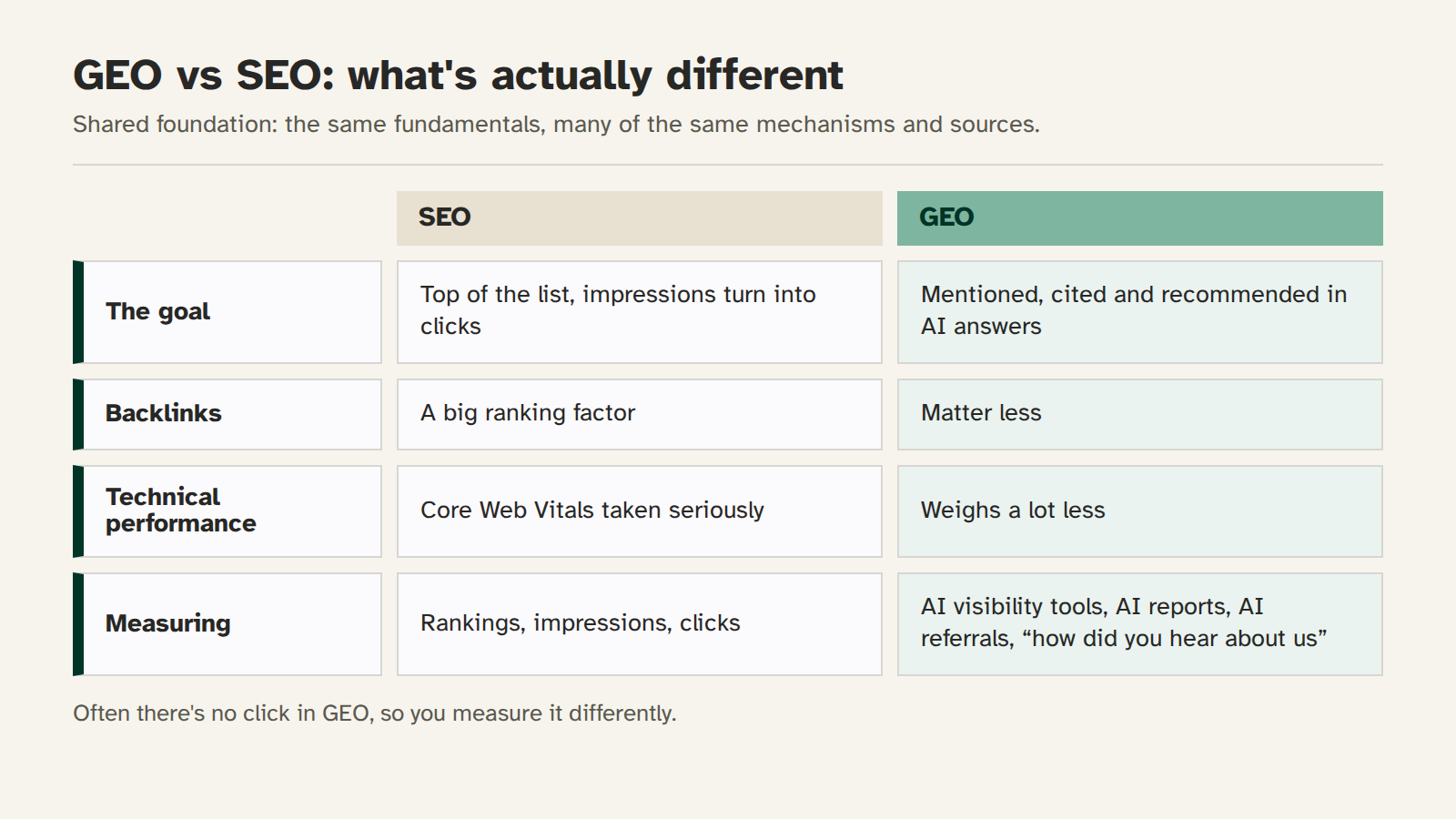
GEO vs SEO: what’s actually different
GEO shares a lot of the same fundamentals as SEO, and even a lot of the same mechanisms and sources. So if your SEO is in decent shape, you’re not starting from zero.
But there are some fundamental differences, and this is where I see companies get it wrong:
- Backlinks matter less. Being mentioned, cited or recommended by an AI tool doesn’t necessarily require a backlink from a trusted website.
- Page speed matters less. Based on my own experiences and the dozens of analyses we’ve done, AI tools put a lot less weight on how fast your site loads than Google does. Google takes Core Web Vitals (its page speed measures) much more seriously. Whether AI tools can read your pages at all is a different story, see the JavaScript point below.
- It’s a different game. Classic SEO is about getting to the top of the list, so your impressions turn into clicks to your site. In GEO most of the value comes from being mentioned and recommended, and that doesn’t necessarily generate a click. Which means attributing and measuring GEO success is very different from SEO. More on that below.
What we keep finding in AI visibility analyses
At Parvi we’ve done dozens of AI visibility analyses by now, mostly for Finnish companies. Three findings come up again and again.
1. The basic informational content is missing. Very surprisingly, this is the main one. Many companies don’t have content on their site that answers the most straightforward basic questions a potential customer has about the product, the service or the organization. If the answer isn’t anywhere, an AI tool can’t give it, let alone recommend you for it. (For local businesses part of the answer also comes from review and listing sites, which I wrote about in AI visibility for local business.)
2. Every AI tool ranks differently. Things that influence Claude don’t seem to influence ChatGPT. And what’s commonly at the top in ChatGPT doesn’t necessarily show up in Gemini’s answers. So “how does AI see us?” is really one question per tool, and the answers can be pretty different. You can see the difference for your own company with my free AI visibility check, which asks ChatGPT, Claude, Gemini and Perplexity the same question and shows which of them name you.
3. AI crawlers don’t get through JavaScript. Google has become a lot better at reading content inside and behind JavaScript. AI crawlers don’t crawl through it. Many sites put their pagination, CTA links or deeper internal links in JavaScript or other non-pure-HTML elements, so AI crawlers can’t reach big portions of the site.
This matches what Vercel found when it studied AI crawler traffic: none of the major AI crawlers it looked at, including OpenAI’s and Anthropic’s, rendered JavaScript. Gemini was the exception, because it uses Googlebot’s infrastructure.
How to start: 4 things to do this month
If you run a Finnish company (or any company, really), this is where I’d start:
- Produce more content. I think lack of content, and lack of consistency in producing it, are among the biggest things companies do wrong. (My own content runs through a team of AI agents, which I wrote about in what agentic marketing looks like in practice.)
- Use what your customer service and sales people know. Ask them for the most common questions and objections they hear about your business, service or product. Then write content that answers them.
- Ask your AI tool for a technical audit. Whatever you already have, Claude, ChatGPT or something else, ask it to run a technical SEO/GEO audit of your website. You’re checking the basics, like whether the site is readable without JavaScript.
- Get the fixes made. Ask your tech person to make them. Or, if you want the full picture across the different AI tools, ask us at Parvi for a deep-dive GEO audit.
How to measure GEO when there’s often no click
A lot of the value never turns into a visit, so I don’t think any single number tells you the whole story. I’d combine these five:
- An AI visibility tracking tool. Tools like Otterly, Profound or the Finnish Superlines track how often AI tools mention you for the questions you care about.
- Google Search Console. It now has generative AI performance reports that show how often your pages appear in AI Overviews and AI Mode.
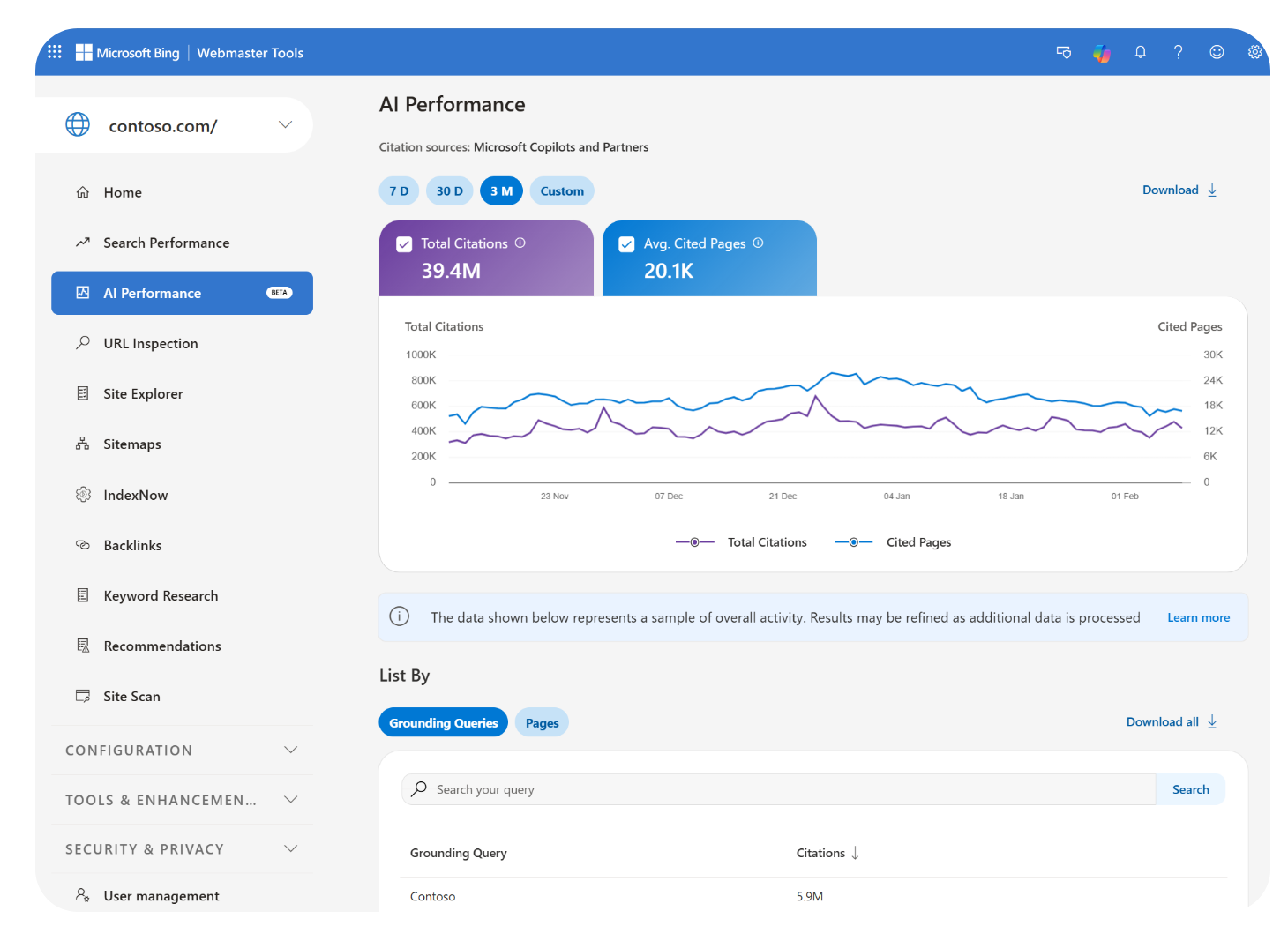
- Bing Webmaster Tools. Its AI Performance report shows your Bing-side AI visibility, like the AI grounding queries where answers lean on your pages and the citations you get.
- Your analytics. Look at referral traffic from AI tools, then follow it through to referral leads and referral sales.
- Self-reported attribution. This one is very important. Make sure your “how did you hear about us” question has AI as an option, or is an open question where people can write “AI”. A recommendation that never produced a click often only shows up here.
Social media has the same problem (value that doesn’t arrive as a click), and I wrote about it in how to measure social media SEO.
Does it actually matter?
My own site: over four weeks this autumn, about 20 of roughly 380 visitors came from AI assistants, mostly ChatGPT. That’s around 5%, and I hadn’t done any work on it yet.
At Parvi it’s more concrete. We’ve already got international leads because ChatGPT recommended us as the best AI marketing agency. So far three leads have told us themselves that they found us through AI. We only know that because we ask.
See what the AIs say about your company. My free AI visibility check asks ChatGPT, Claude, Gemini and Perplexity which companies they recommend in your field, and shows whether yours is on the list. It takes under a minute, and you get one free check a day.
More on AI visibility
- AI visibility for local business: why the ChatGPT and Yelp deal matters for local companies.
- Company rename GEO: why AI tools keep using your old name after a rename, and what to fix.
- How to measure social media SEO: measuring value that doesn’t arrive as a click.
- ChatGPT Search Console: what ChatGPT’s reported business reporting tool would show, and how I track AI visibility meanwhile.
If you’d rather have someone run this for you, this is what we do at Parvi as GEO optimization, starting with the deep-dive analysis.
FAQ
What is meant by GEO?
GEO stands for generative engine optimization. It's the practice of optimizing your online presence (your website, social media profiles, digital PR and content) so that generative AI tools like ChatGPT, Gemini and Claude mention, cite and recommend you when people ask about your topics.
What is the difference between GEO and SEO?
They share a lot of the same fundamentals and many of the same sources. The difference is the game. SEO is about getting to the top of the list and turning impressions into clicks. In GEO most of the value comes from being mentioned and recommended inside an AI answer, which often doesn't produce a click at all. In my experience backlinks and technical site performance also weigh less in GEO than in Google SEO.
What is GEO on a website?
On your own site, GEO mostly means two things. Content that plainly answers the basic questions customers ask about your product, service or company. And a site that AI crawlers can actually read, which in practice means the important content and links are in plain HTML, not behind JavaScript.
What does AEO stand for?
AEO stands for answer engine optimization. It describes roughly the same work as GEO: getting your content picked up and used in the answers AI tools and search engines give. Different people use different names, but the practical to-do list is largely the same.
How do you measure GEO?
With a mix of signals, because a lot of the value never shows up as a click: an AI visibility tracking tool, the AI reports in Google Search Console and Bing Webmaster Tools, referral traffic and leads from AI tools in your analytics, and self-reported attribution, meaning a "how did you hear about us" question where AI is an option.

Written byOtso Karvinen
I design and build agentic AI systems for marketing and sales teams. Co-founder of Parvi.