AI visibility for local business: the Yelp deal just raised the stakes
On this page
AI visibility means how often an AI assistant mentions or recommends your business when someone asks it for help. AI visibility for local business just became a much more concrete topic: ChatGPT now has access to Yelp’s reviews, ratings, photos and business information, and uses them for local recommendations.
I recorded a quick take on the news when it broke:
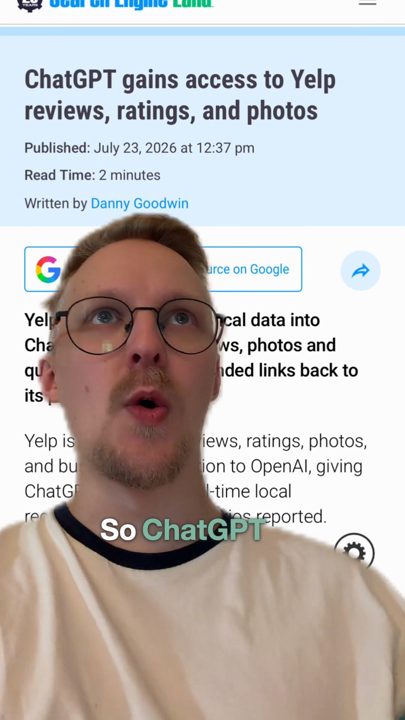
This article is the longer version: what the deal actually covers, why I think it matters more than it looks, and what I’d do about it this month if I ran a restaurant or a local service company.
What actually happened
Yelp is licensing its content to OpenAI: reviews, ratings, photos and business information, at the scale of about 330 million reviews and over 8 million business listings. ChatGPT can use that data in local recommendations, with Yelp branding and links shown when its content appears. OpenAI controls how the experience looks. Yelp’s Request a Quote feature is also coming to ChatGPT, so users will be able to contact local service providers directly from a conversation.
Worth knowing: this is Yelp’s story so far, not OpenAI’s. The deal surfaced in Yelp’s Q4 2025 earnings in February and the details came out via Axios and Search Engine Land in July. OpenAI hasn’t published its own announcement. The deal is non-exclusive, so Yelp can license the same data to other AI companies, and it already has form here: Yelp content has powered Apple Maps since 2012 and did the same for Yahoo’s local search in 2014.
My first reaction was surprise. Then it started to make sense. Google owns most of the local search and local business game, and ChatGPT competes with Google for exactly the kind of intent-heavy moments where local decisions get made. If you want to answer “where should I eat tonight” or “who can fix my roof”, you need local data. Yelp had it to sell.
Why this matters more than it looks
The adoption curve is the part I’d not sleep on. BrightLocal’s 2026 consumer survey found that the share of US consumers using AI for local business recommendations jumped from 6% to 45% in a year. In the same survey, AI is already the third most-used source for local recommendations, ahead of Yelp itself and TripAdvisor. US data, roughly a thousand respondents, so hold it loosely. But the direction is hard to argue with.
The traffic that comes out of these assistants also behaves differently. Ahrefs measured AI search visitors converting at roughly 23 times the rate of organic visitors on their own site, and Semrush’s study valued an AI search visitor at 4.4 times a traditional organic visitor. Both come with caveats, small or single-site samples, and the authors say so themselves.
I can add my own receipt. Since I started doing generative engine optimization properly on this site (the same measurement thinking I described for social media SEO), ChatGPT referrals have grown, and the people who arrive that way convert unusually well. Last week a senior decision maker called me directly: he’d asked ChatGPT for help turning his e-commerce business into an agentic machine, and ChatGPT had recommended me as a top AI marketing expert in Finland and handed him my contact information. We didn’t end up working together, our needs didn’t quite match, but that call is what AI visibility looks like in practice. I didn’t pay for it and I wasn’t competing in a results page. I was simply the answer he got.
The arbitrage window
The value in moments like this goes to whoever moves while it’s still awkward. Very few local businesses are going to put their Yelp pages together, especially local service companies. That’s the arbitrage. The recommendation slots in a ChatGPT answer are few, the data source is now known, and almost nobody is competing for it yet.
This is doubly true outside the US. Take Finland, where I work. Yelp launched here in 2012, then wound down its international operations in 2016, and local reputation has lived in Google reviews and Google Business Profile ever since. The Finnish Yelp site still exists, mostly empty. Which creates a strange gap: ChatGPT’s best licensed source for local recommendations is a platform an entire market never adopted. I’d rather be one of the few Finnish companies with a real profile on it than wait to see how the gap resolves.
What I’d do this month
If you run anything local, a restaurant, a clinic, a repair shop, a services firm:
- Claim your Yelp profile. Set it up if it doesn’t exist, own it, get the basics right: category, hours, photos, contact details.
- Update it on the same cadence as your Google Business Profile. Yelp now feeds ChatGPT the same way Google’s profile data feeds Google’s own ecosystem, Maps, search and its AI answers.
- If you’ve never done Google Business Profile optimization, start now. It was already worth it before AI assistants. Now both major profile surfaces are inputs to machines that recommend businesses in plain sentences.
- Keep your business information consistent everywhere. Assistants cross-check. Conflicting hours or addresses between your site, Google and Yelp is exactly the kind of thing that costs a recommendation.
The upkeep part is where this gets interesting for me. I’ve built an agent that takes company news, newsletters, social posts and website updates, and turns them into local SEO-optimized Google Business Profile posts on a schedule. I’m setting it up for a company I work with right now, and extending the same pattern to Yelp is the obvious next step. Profile upkeep across channels is boring and it repeats every week, which is exactly the shape of work agents are good at.
What I don’t know yet
Honest uncertainties, because there are several. Nobody outside OpenAI knows how heavily Yelp data will actually weigh in ChatGPT’s answers, or how the experience will look once it ships fully. The deal being non-exclusive means the map of who-reads-what will keep shifting. The conversion studies are early and small. And in markets like Finland it’s possible ChatGPT ends up leaning on other signals for local answers, in which case the Yelp bet cost you an afternoon.
That’s the trade I’m taking anyway: an afternoon of profile work against the chance of being the answer when someone asks ChatGPT who to hire.
Let’s see how this develops.
FAQ
What is AI visibility?
How often and how favorably AI assistants like ChatGPT, Gemini and Perplexity mention or recommend your business when people ask them for help. It depends on the data sources each assistant licenses and reads, so it overlaps with SEO but isn't the same thing.
How does a local business show up in ChatGPT recommendations?
ChatGPT now licenses Yelp's reviews, ratings, photos and business information for local recommendations, so an up-to-date Yelp profile is the most direct lever we know of. Beyond that: a complete Google Business Profile, consistent business information across the web and real reviews.
Do I need a Yelp profile outside the US?
Probably yes, even in markets where nobody browses Yelp. The value is no longer Yelp's own audience, it's that ChatGPT reads Yelp's data. In Finland, for example, Yelp has barely been used since 2016, which means claiming and updating your profile there is cheap and almost nobody is doing it.
Is traffic from ChatGPT actually worth anything?
The early published numbers say it converts unusually well. Ahrefs measured AI-search visitors converting at roughly 23 times their organic rate on their own site, and Semrush's study put the value of an AI search visitor at 4.4 times a traditional organic visitor. Small samples and early days, but my own experience points the same way.