Company rename GEO: why AI still uses your old name
 Otso Karvinen · Co-founder of Parvi
On this page
Renaming your company used to be an SEO problem. Now it’s a GEO problem too. (New to the term? Here’s what GEO is in full.)
Company rename GEO means making sure AI assistants like ChatGPT use your new name and get the facts about the company right. GEO (generative engine optimization) is the work of improving how AI describes you, and a rename is one of the cases where it can go badly wrong for longer than you’d expect. If you want the wider picture first, I wrote about what AI visibility means for a local business.
I recorded a quick take on this when I posted about it:

Google forgives a rename faster than AI does
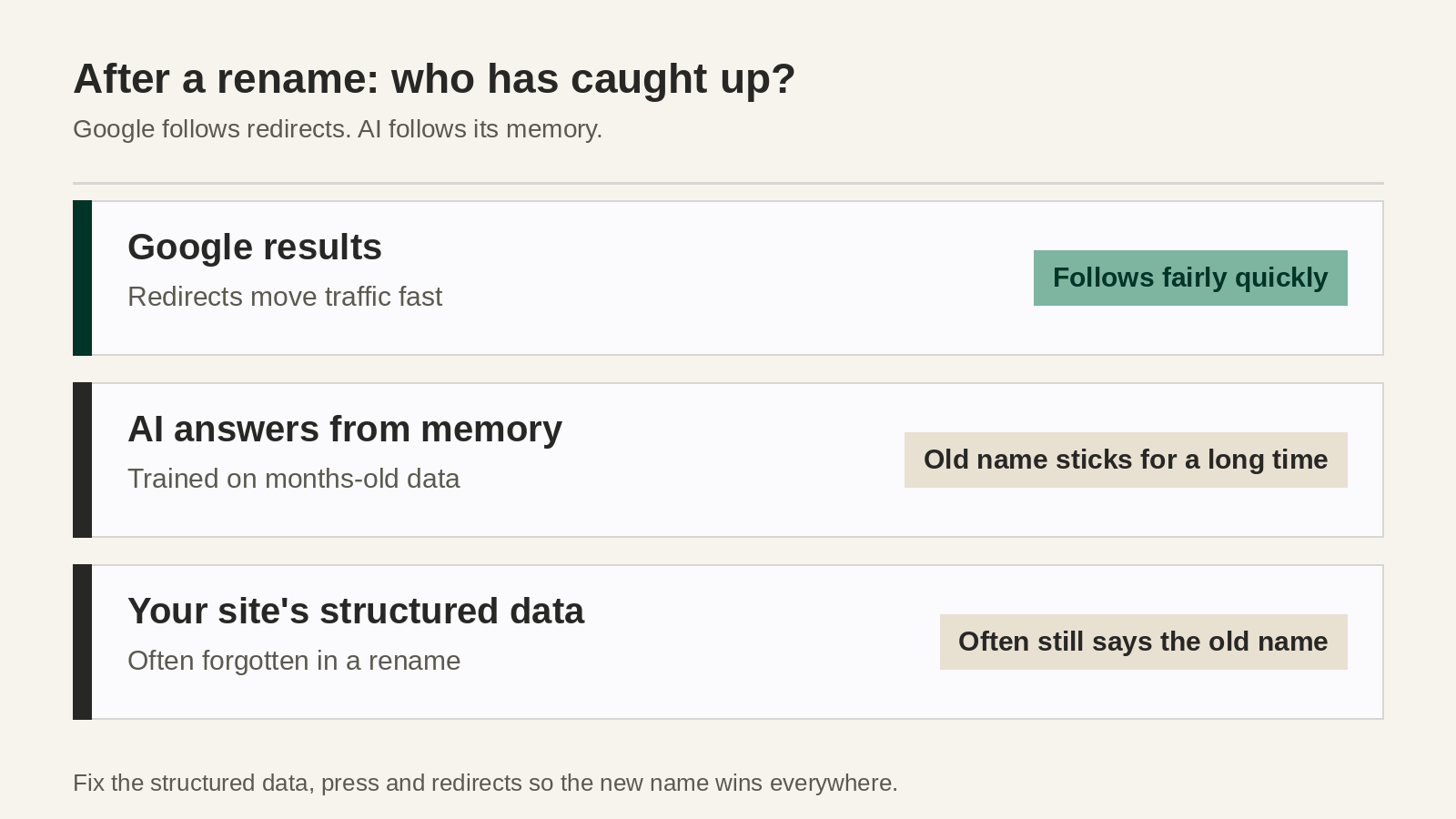
With Google, redirects do most of the work. Set them up properly and the traffic follows the new name fairly quickly.
AI has a stickier memory. Language models learn from training data that’s months or even years old, so the old name is what they know, for a long time. That matters most when they answer from memory instead of searching the web, which they tend to do more often than people think.
The result is that for quite a while you’re two different companies in the eyes of ChatGPT and other AI tools. To see whether the AI tools know your new name yet, my free AI visibility check asks ChatGPT, Claude, Gemini and Perplexity about your company and quotes what each one says.
What we found in a real company rename audit
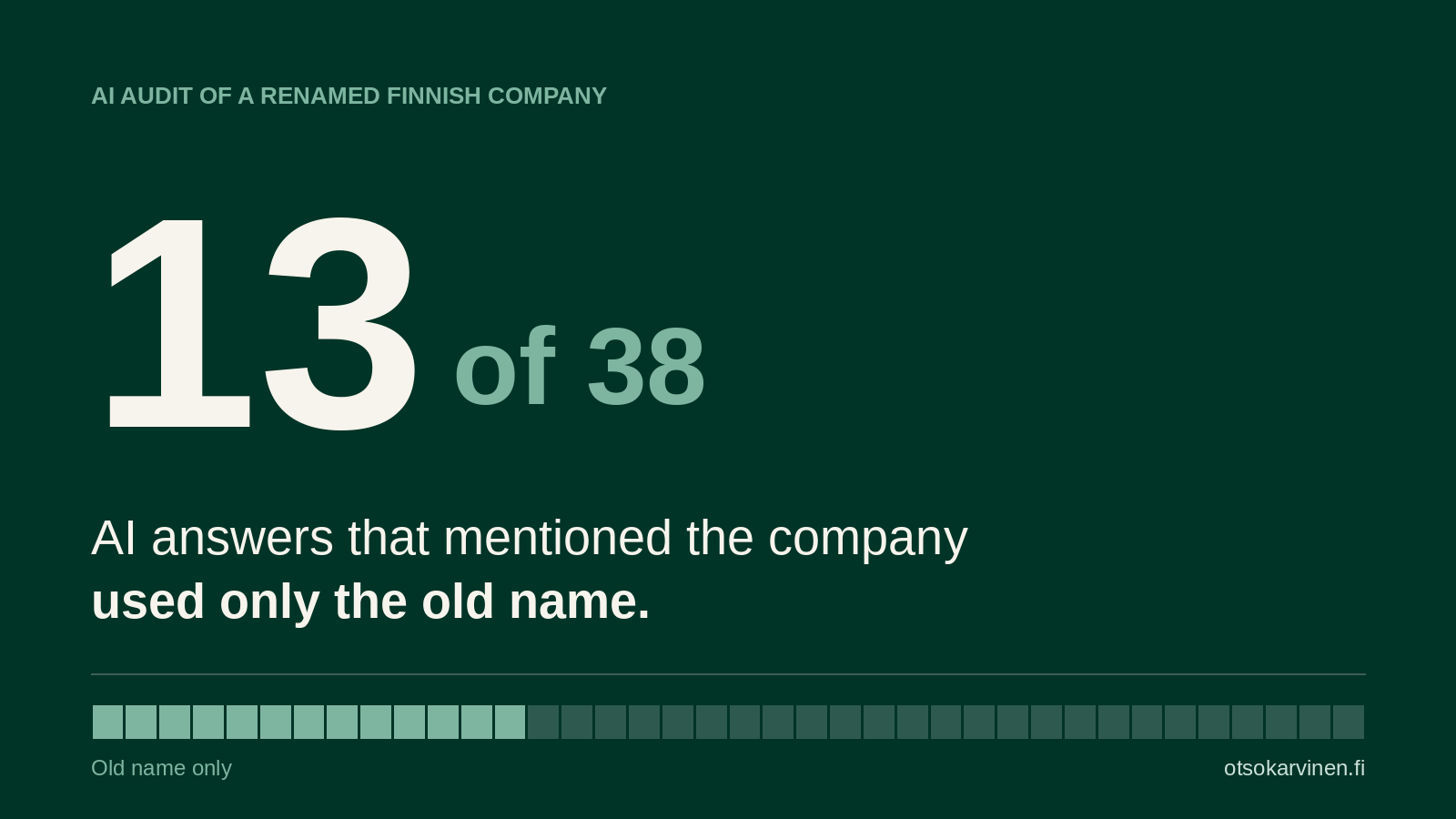
We recently audited a Finnish industrial company that had changed its name. I can’t name them, but the numbers are real:
- 13 of the 38 AI answers that mentioned the company, about one in three, used only the old name.
- The company’s own website still had the old name in the structured data that machines read.
- People were still googling the old name: 482 clicks in 90 days.
The structured data part didn’t surprise me much, because I’ve seen it in quite a few of our AI visibility audits. Companies either have no structured data at all, like the Organization schema, or what they have is incorrect and doesn’t match the official company name. Often the official name and the business ID aren’t even on the page in plain text.
Why a rename is a bigger marketing risk now
A customer who asks an AI assistant about a company and gets the old name might never find the new site. Or they find a company that, as far as the assistant knows, is a different one.
Your brand is split in two, and the old half has the head start. The old name has years of reviews, press and links behind it. The new one has a launch announcement.
What to do about it
You can’t edit an AI’s memory, so the job is to make the new name easier to find and trust than the old one. A few things that help:
- Update your structured data. The markup on your own site is the first place machines look. If it still says the old name, you’re telling them the old name is right. Check that your Organization schema exists and that the legal name in it matches your official registered name.
- Put the official name and business ID on the page. In plain text, somewhere machines and people can both find it, like the footer or the contact page.
- Tell Google and the AI crawlers consistently. Use structured data, press releases and website content that all say the same thing about the name change and the new company.
- Get the change into third-party sources. Directories, news, partner sites and profiles. Assistants lean on what the wider web says about you, not only what you say.
- Keep your redirects consistent. If clients click an old link, they should still land on the right page of the new company. Don’t send everything to the homepage.
- Keep the old name findable on purpose. People will keep searching for it. A line like “formerly X” on the right pages helps both people and machines connect the two.
The Organization schema was the quickest thing to edit, so that’s what the client fixed first. It’s a good place to start for the same reason: it takes little effort and it’s the first thing machines read.
How to check where you stand
Ask a few AI assistants about your company in the ways your customers would. Do it a few times, because answers change between runs. Count how often the old name shows up on its own. That’s your starting number, and it’s the one to track as the fixes kick in.
Then check your own site for the old name in places a visitor never sees, like structured data, page titles and image descriptions. If you’d rather have someone do it properly, that’s what our GEO audit at Parvi covers: we check whether ChatGPT and other AI tools mention your company, and with which name.
The short version
A rename used to mean a few weeks of watching your Google traffic settle. Now it also means watching what AI says about you, and fixing it on purpose.
If you’re planning a rename, treat GEO as part of the plan from day one, not as cleanup afterwards. That’s the kind of GEO optimization we do at Parvi, the agentic AI agency I co-founded.
Test your new name with the four big AIs. My free AI visibility check asks ChatGPT, Claude, Gemini and Perplexity about your company and shows what each one answers, so you can see whether they use the new name. It’s free and takes under a minute.
FAQ
Does changing a company name hurt SEO?
Usually only for a while. With Google, consistent 301 redirects pass most of the value to the new pages and traffic tends to follow the new name fairly quickly. The bigger risk now is that AI assistants keep using the old name for much longer.
How long do AI assistants remember an old company name?
Nobody can give you an exact number. Language models learn from training data that's months or even years old, so the old name can stick around for a long time, especially when the assistant answers from memory instead of searching the web.
How do I get ChatGPT to use my new company name?
You can't force it, but you can make the new name the easiest thing to find and trust. Update your structured data, publish the change on your own site and in third-party sources, and keep your redirects consistent so every old link ends up on the new company.
What is GEO?
GEO, or generative engine optimization, is the work of making sure AI assistants like ChatGPT, Gemini and Perplexity mention your company, and get the facts about it right.

Written byOtso Karvinen
I design and build agentic AI systems for marketing and sales teams. Co-founder of Parvi.