ChatGPT Search Console: how I measure AI visibility until it launches
 Otso Karvinen · Co-founder of Parvi
On this page
OpenAI is reportedly building a ChatGPT Search Console. As part of a larger “Business Hub”, a verified business could see a daily chart of how often ChatGPT mentions it and how many people click through to its site. It would not show the questions behind those mentions, who asked them or how competitors are doing. OpenAI hasn’t confirmed any of it, and there’s no launch date.
AI visibility means how often AI assistants mention, cite or recommend your company. If the term is new, start with what GEO is. I wrote up the news itself on Parvi’s site. This one is about what I actually measure on my own site while we wait.
What is the ChatGPT Search Console?
It’s the nickname for a tool OpenAI hasn’t announced. Juozas Kaziukėnas, founder of Marketplace Pulse, shared a LinkedIn screenshot of a ChatGPT banner inviting businesses to “claim your business in ChatGPT”. On 6 November 2026 Search Engine Roundtable and PPC Land both reported on it.
Based on the screenshot and his description, this is what it would and wouldn’t do:
| Reportedly shows or does | Reportedly doesn’t show |
|---|---|
| How often ChatGPT mentions your business, as a daily chart | The questions people asked |
| How many clicks those answers send to your site | Who asked them |
| Lets you add products and keep your details up to date | How competitors are doing |
| Lets you set up your own business agent (a chatbot that answers customers’ questions) |
Only businesses that verify ownership would get in, for example by connecting a Shopify store. Kaziukėnas said he’d seen early versions since August and that the new banner suggests a launch is getting close.
How do I track AI visibility today?
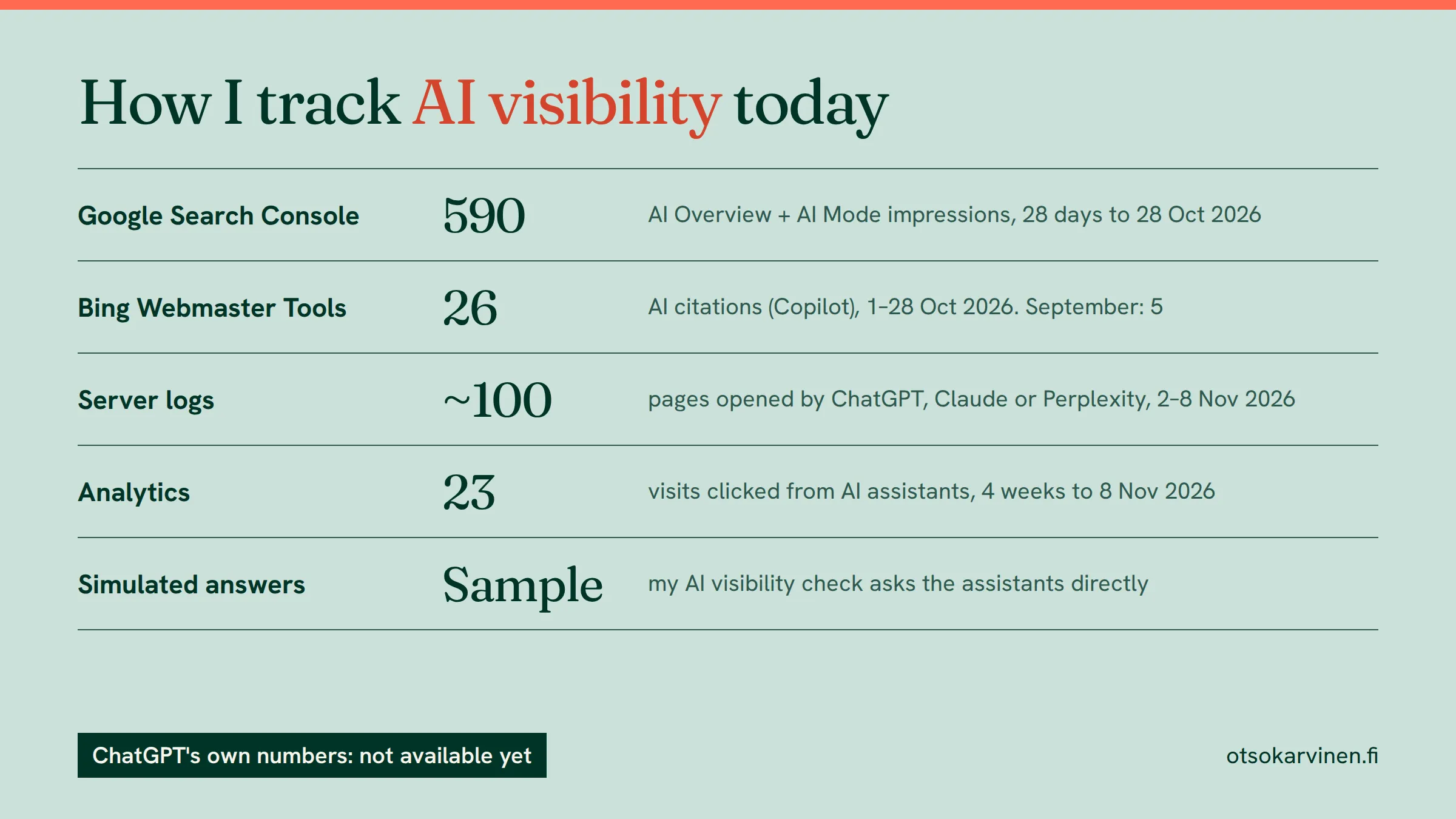
I’ve measured AI visibility since 2024. On otsokarvinen.fi I use five sources, because none of them tells the whole story alone:
- Google Search Console. Its generative AI report shows how often my pages appear in Google’s AI answers (AI Overviews at the top of the results and the chat-style AI Mode). In the 28 days to 28 October 2026 that was about 590 impressions, rising from roughly 12 a day at the start of October to about 41 a day at the end. I have to export it by hand, because Google doesn’t offer this report through its API (the data connection other tools use) yet.
- Bing Webmaster Tools. The AI Performance report counts how often Microsoft’s AI answers, Copilot included, cite my pages. 26 citations from 1 to 28 October. September had 5 and August 11, so the numbers still jump around.
- My server logs. When someone asks ChatGPT, Claude or Perplexity something and the assistant opens one of my pages to answer, it shows up in the Cloudflare logs under its own name (ChatGPT-User, Claude-User, Perplexity-User). From 2 to 8 November 2026 that happened about 100 times. Some of those are just the assistant checking robots.txt (the file that tells bots what they may read), so I treat it as a rough signal.
- My analytics. Visits where someone clicked through from an AI assistant. 23 in the four weeks to 8 November, up from 20 the four weeks before. Almost all of them came from ChatGPT.
- Simulated answers. My free AI visibility check asks ChatGPT, Claude, Gemini and Perplexity which companies they recommend for what you sell, and shows whether you’re on the list. That’s a sample of answers at one moment, not a count of every conversation.
The gap is easy to see from that list. Google and Bing give me first-party numbers (data from the platform itself). For ChatGPT, which sends me almost all of my AI visits, I only see the clicks that land on my site, the page visits in my logs and my own sample questions. Every mention that didn’t produce a click is invisible to me.
What would ChatGPT’s own numbers change?
For me, mainly two things.
First, it would be a real count. Most AI visibility tools, mine included, send the assistant a set of questions, collect the answers and count the mentions. Even done well, that’s a sample. OpenAI’s numbers would come from the actual conversations.
Second, I could finally check whether the work pays off. If I rewrite a page so it answers a question better, I’d like to see whether ChatGPT starts mentioning me more. Right now I can only guess from the clicks. To me, once you can measure your visibility better, you can also start to influence it better.
Do AI visibility tools still matter?
I don’t think first-party data makes the tracking tools useless. If the reports are right, the Business Hub shows the score but not the reasons behind it. Kaziukėnas put it this way: it “won’t help understanding why mentions/clicks are increasing or decreasing”, but combined with tools that track the questions, it would show whether your GEO efforts pay off.
So the tools still tell you why: which questions mention you and who gets recommended instead of you. I’d say the competitor part matters most, because a chart of your own mentions going down doesn’t tell you that a competitor just took your place.
What should you do now?
- Turn on what already exists. The generative AI report in Google Search Console, the AI Performance report in Bing Webmaster Tools and the visits from AI assistants in your analytics. If you use Microsoft Clarity, it now shows what AI agents do on your site too.
- Get your details in order before the Business Hub opens. If it launches, you want your products and business details current from the first day. If you run a Shopify store, watch for the “claim your business” banner, since connecting the store is one reported way to verify. And if you’ve renamed your company, check that AI isn’t still using your old name.
- Write down a baseline today. Run the questions your buyers actually ask through the AI tools and note where you’re mentioned. Then when real ChatGPT numbers arrive, you have a before to compare against. My free AI visibility check is one quick way to do it.
If you’d rather have someone set up the measurement and do the work that gets you mentioned, that’s what we do at Parvi as GEO optimization. For a local business angle on the same topic, see AI visibility for local business.
FAQ
Is there a Search Console for ChatGPT?
Not yet. OpenAI is reportedly building one, a "Business Hub" where a verified business could see how often ChatGPT mentions it and how many people click through. It was reported on 6 November 2026 based on a screenshot, and OpenAI hasn't confirmed it or given a launch date.
What would the ChatGPT Search Console show?
Based on the reports, a daily chart of how often your business appears in ChatGPT's answers and how many clicks those answers send to your site. You could also add products, keep your business details up to date and set up your own business agent. It would not show the questions people asked, who asked them or how competitors are doing.
Can I connect Google Search Console to ChatGPT?
Some third-party tools let ChatGPT read your Search Console data so you can ask questions about it. That's a different thing. It shows your Google data inside ChatGPT, while the reported Business Hub would show ChatGPT's own data about your business.
What is AI visibility tracking?
Measuring how often AI assistants like ChatGPT, Gemini, Claude and Perplexity mention, cite or recommend your company, and what traffic that brings. Most tracking tools do it by asking the assistants a set of questions and counting the mentions, so the result is a sample, not a full count.
How can I track AI visibility for free?
Start with what you already have: the generative AI report in Google Search Console, the AI Performance report in Bing Webmaster Tools and the visits from AI assistants in your analytics. For a quick snapshot of what the assistants say about you, my free AI visibility check runs the questions for you.

Written byOtso Karvinen
I design and build agentic AI systems for marketing and sales teams. Co-founder of Parvi.