How I write a sales proposal in 15-30 minutes with AI agents
 Otso Karvinen · Co-founder of Parvi
On this page
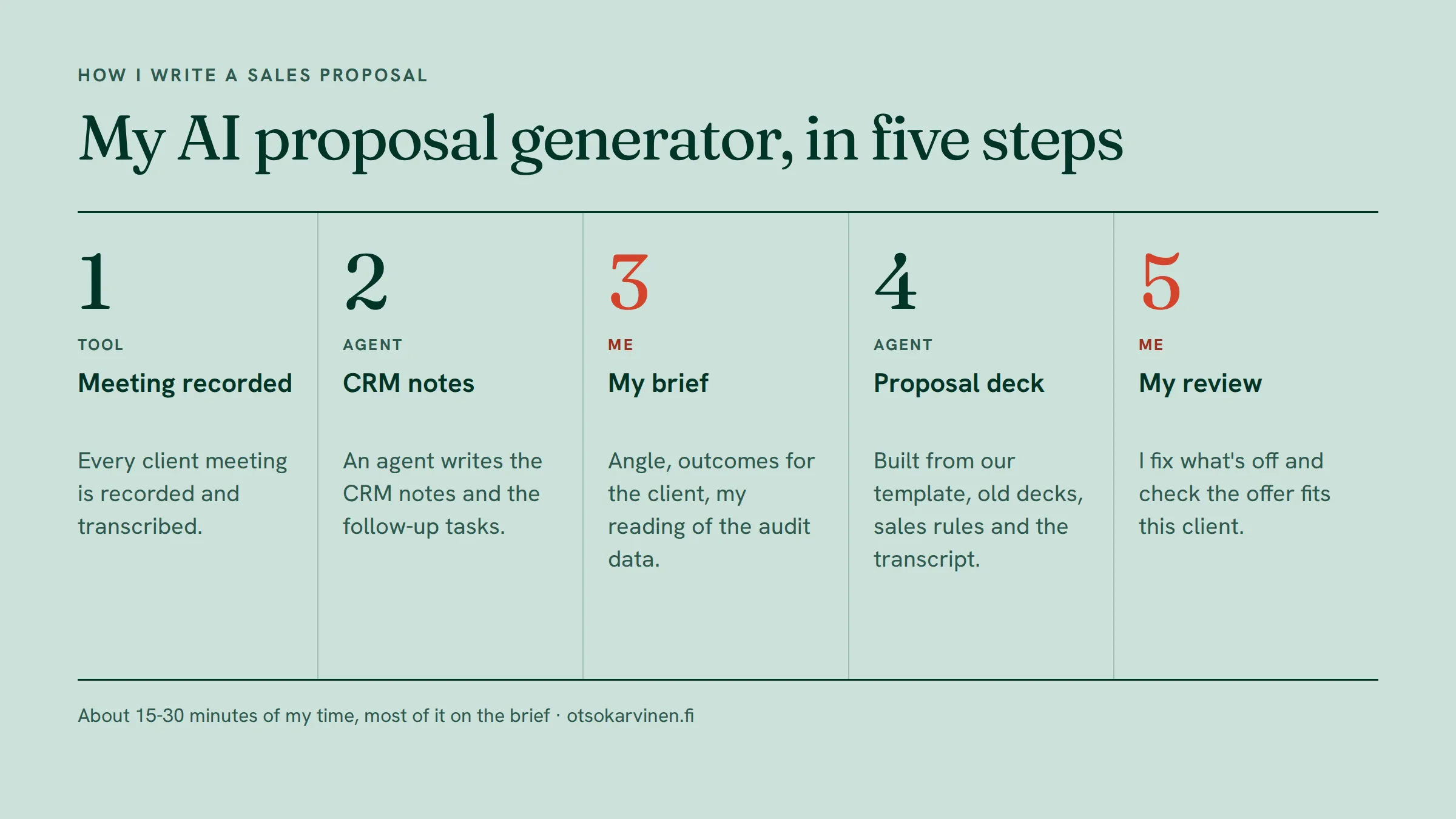
Writing a sales proposal now takes me about 15-30 minutes of work.
The last few weeks have been heavy on sales. Most of my hours went into prepping calls, doing them, following up and writing offers, so that’s where I started focusing our agent building. Before, one proposal took me a few hours at least.
My AI proposal generator isn’t one app. It’s a small chain of AI agents, a kind of AI sales assistant with one job: turning a recorded sales meeting into a proposal deck. (An agent is AI that carries out a multi-step task on its own instead of just answering a question.) I write the brief and check the result. If agents in marketing and sales are new to you, I’ve written about the bigger picture in what agentic marketing is.
What did writing a proposal look like before?
It was usually a lot of searching for old offers and proposals and copying bits from them, or drafting from scratch. Putting it all together took a few hours at least.
| Before | Now | |
|---|---|---|
| Where the content came from | Old proposals I searched for and copied, or a blank page | The meeting transcript, our template, previous sales decks and our sales rules |
| My time per proposal | A few hours at least | About 15-30 minutes |
| What my time goes into | Putting it all together | The brief and the review |
How does my AI proposal generator work?
- The meeting gets recorded. We record every client meeting with MeetGeek (not an affiliate, I just really like the tool).
- An agent writes the CRM notes. It goes through the transcript (the written text of the meeting), writes the notes into our CRM (the system where we keep track of clients and deals) and creates the follow-up tasks.
- I write the brief. The angle, the outcomes for the client and how I read their situation. More on this below.
- The proposal builder makes the deck. The same transcript goes into it. It builds the deck from our template, our previous sales decks and our sales doctrine, which is our written rules for how we sell and put offers together. On top of that it uses what the client actually said in the meeting.
- I review it. I fix what’s off and make sure the offer matches how I see us approaching this client.
Recently we switched the builder from HTML decks (slides built as a web page) to Claude’s slides, which is basically PowerPoint inside Claude (Anthropic’s AI assistant). Anthropic’s own announcement covers how Claude creates and edits PowerPoint decks and other files.
All in all, it has cut our proposal time by maybe 75%. That has been a huge help during these hectic weeks.
Where do my 15-30 minutes go?
Most of it goes into the brief, not the review. I draft the brief from the research we’ve done on the company, the meeting transcripts and the other conversations we’ve had with the client. (More on the research side in how I use AI for sales prospecting.)
The rest is the review, and it’s still needed. The agent can get the angle, the focus or the details wrong and miss some nuance. So nothing goes out without me reading it first.
What do I still write myself?
In practice I write three things into the brief:
- The angle I want the proposal to take.
- The outcomes the client would get working with us.
- My reading of the situation. I interpret the data from the audit and the client’s current situation and challenge, and how that matches what we can do for them.
So the more strategic stuff gets written by me directly.
What have clients said about the proposals?
I’ve gotten a lot of good feedback on the speed, that’s for sure.
One client did say that the offer sounds like Claude. In that particular case, it was a positive.
More on where our first deals came from: founder-led sales.
Where should you start with AI agents for sales?
If you want to build your own version, start by feeding Claude your own material:
- Your sales materials, especially winning deals and the decks that went with them.
- Your sales process or model, written down: how you sell and how you put offers together.
- Your brand guidelines and tone of voice.
- Your templates.
If you want your team to build agents like this themselves, that’s what my AI in marketing training is about. And if you’d rather have it built for you, our agency Parvi sets up AI agents for business.
This article started as a LinkedIn post.
FAQ
How can I use AI in my sales role?
Start with the writing around the sale. In my setup an agent goes through each meeting transcript, writes the CRM notes and creates the follow-up tasks, and a proposal builder drafts the proposal deck from the same transcript. I write the brief and review every proposal before it goes out.
What is the best AI proposal generator?
I can't rank the tools, because I don't use a ready-made proposal app. My AI proposal generator is a small chain of agents, and the proposal builder works in Claude. It builds from our own template, our previous sales decks, our written sales rules and what the client said in the meeting. Whatever tool you look at, check that you can feed it that kind of material.
Is there a free AI proposal generator?
Some proposal tools offer free AI generators. What makes my setup useful is the material behind it: the agent builds from our own template, our previous sales decks and our written sales rules, not from a blank form.

Written byOtso Karvinen
I design and build agentic AI systems for marketing and sales teams. Co-founder of Parvi.