Founder-led sales: where Parvi's first customers came from
 Otso Karvinen · Co-founder of Parvi
On this page
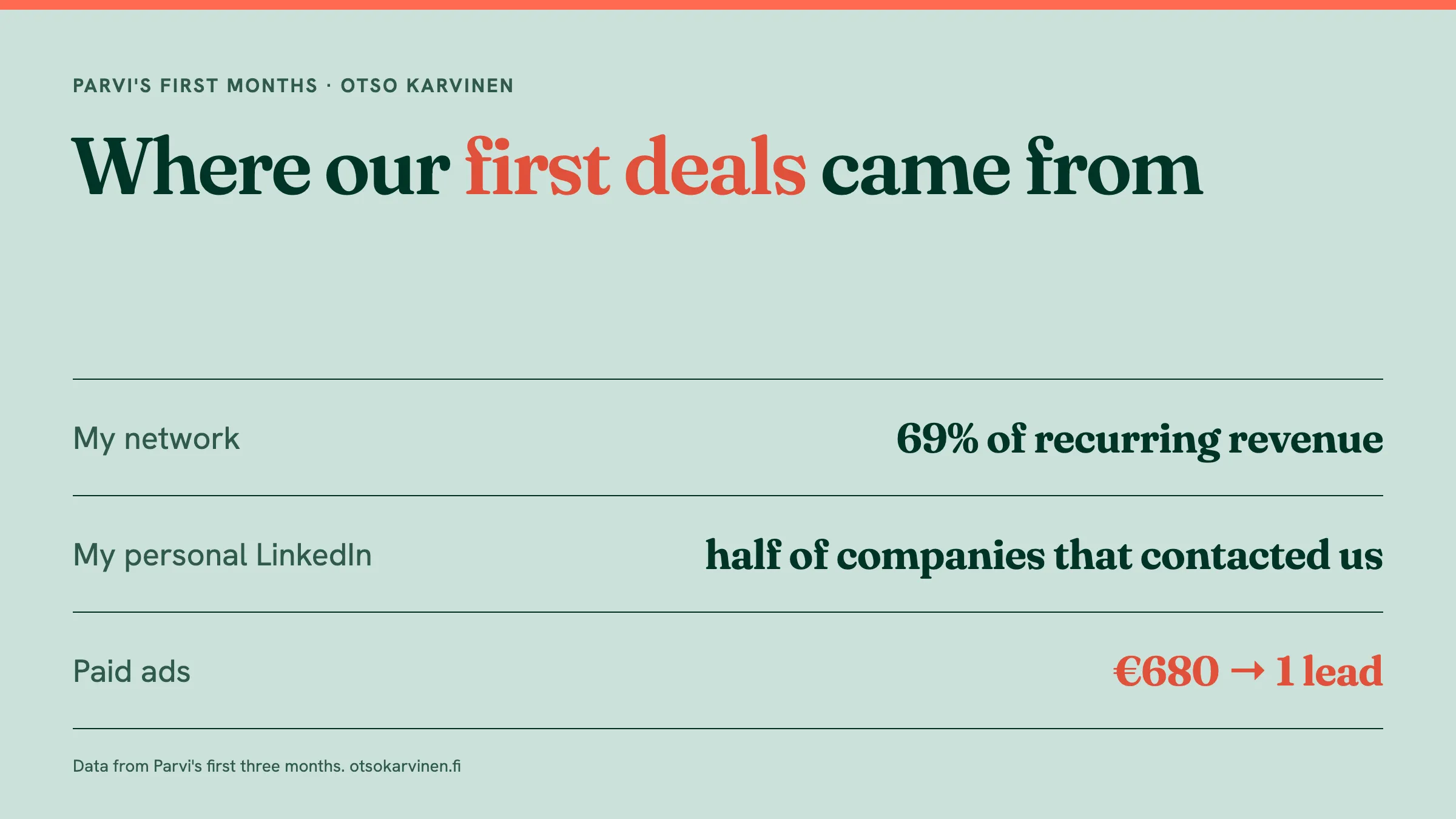
Founder-led sales has worked for us in Parvi’s first months. My personal brand and network brought in a lot of the companies that contacted us and most of our recurring work.
Founder-led sales means the founders do the selling themselves in the early days, before there’s a sales team. They sell on their own name and contacts. Most guides on it are written for software startups. This one is from a services company, with our own numbers. (I’m Otso Karvinen, a co-founder of Parvi and an AI marketing consultant in Helsinki.)
Where did Parvi’s first deals come from?
A big share came through my personal brand and network. Work also comes through our parent company, Into Digital, but this article is about the personal brand side.
| What we measured | Result |
|---|---|
| Recurring revenue (the monthly work) | 69% came through my network |
| Companies that contacted us first | Half found us through my personal LinkedIn |
| Video reach on LinkedIn | My profile reached about four times as many people as the Parvi company page |
Smaller sources include my co-founder Mari’s network and recommendations. And people keep contacting us just because we share what we’re building at Parvi and why.
Why is personal branding important for founder-led sales?
Because you’re not selling to strangers. My network brought in 69% of our recurring revenue (the monthly work, not one-off projects). And half of the companies that contacted us first found us through my personal LinkedIn.
When we post the same video on both, my own LinkedIn reaches about four times as many people as the Parvi company page. And when a LinkedIn lead wants to buy, the conversation moves to my LinkedIn messages.
Since 6 September we’ve asked people who contact us where they heard about us. The large majority of those who answered said LinkedIn. That’s a small sample, so I’d call it a direction, not proof.
I also hear “I’ve followed your posts for years” all the time. A lot of the companies that contact us say they’ve been following for a long time. In most cases they’ve been my LinkedIn contact for a while, and we’ve had some kind of interaction before.
That’s the head start. Some of the trust is already there before the first call.
The flip side: the LinkedIn leads that turned into actual sales came from people who already knew me. Leads from people who didn’t know me haven’t turned into a single sale yet.
How long does it take to build a personal brand that sells?
In my case, about four years of doing it properly. It didn’t start when Parvi did.
Here’s what I actually did:
- Wrote, a lot. Mostly on LinkedIn, and very consistently.
- Went after stages. I’ve purposefully looked for speaking slots, podcasts and events. I set a yearly goal for how many times I speak in public, and I try to hit it. (My talks are on my speaker page.)
- Showed up in person. At my previous job at Quru, I went to as many marketing events as I could and networked consistently.
- Kept the conversations going. I connected with marketing and sales leaders and peers on LinkedIn, and kept talking with them there.
None of it is fast. But when Parvi started, most of that work was already done.
What else looks promising?
A few smaller things look promising, but it’s early:
- Free audits. A couple of weeks of free audits turned into a double-digit number of meetings. It’s still early to say how many become paid work.
- Events. One event evening brought us several new potential sales.
- Search. Our website’s search impressions (how often it shows up in Google’s results) grew many times over in a few months. Most of the clicks still come from people searching for Parvi by name.
What didn’t work?
Paid ads and leads from people who didn’t know us haven’t worked so far:
| What we tried | Result |
|---|---|
| Paid ads | €680 spent, 1 lead |
| LinkedIn leads from people who didn't know us before | 0 deals won |
| Parvi's smaller social media channels | A typical post (the median) gets 7 to 45 impressions (times it's shown), depending on the channel |
| Outbound (contacting companies ourselves) | Not started yet |
Outbound isn’t a failure, we just haven’t done it yet.
Should you pick a co-founder for their network?
I wouldn’t pick a co-founder based on that alone. But it’s a good thing to consider, and not only for co-founders. It’s worth thinking about for any hire too.
We noticed it afterwards. All three of us had strong personal brands and networks, and they were built in very different places:
- Me: mostly marketing leaders.
- Aapo: a lot of senior and commercial leaders in Finnish companies.
- Mari: tech and startup people.
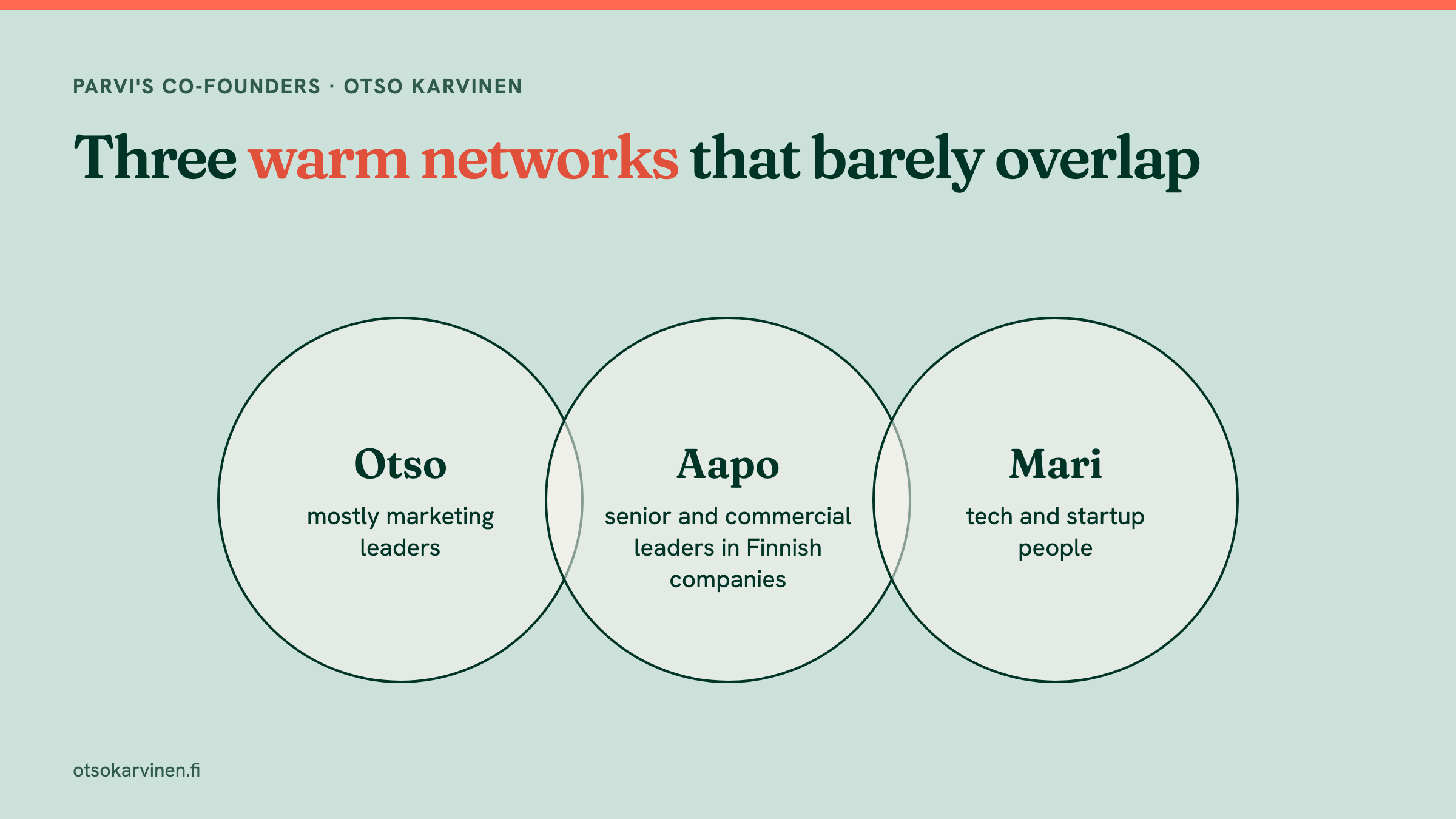
So from the start we could reach three warm networks that don’t overlap much. One commenter on my LinkedIn post explained why this matters: most founding teams know the same people, so introductions through people you know run out fast.
Does founder-led sales work for a services company?
Yes, in our case it has. Most founder-led sales advice is written for software startups (the classic book is Pete Kazanjy’s Founding Sales).
Parvi is an agency, not a software company, and so far the same approach has worked well for us. Paid ads, by comparison, have brought us exactly one lead.
What does founder-led marketing cost you?
Founder-led marketing means the founders are the face of the company’s marketing, under their own names.
Of course it takes time. And sometimes it attracts negative attention too.
The cringe mountain
On top of that, you have to work to get over the cringe mountain (the awkward feeling of putting yourself and your work out there in public).
But it’s so worth it in the end.
Is a personal brand worth it for a new company?
If you’re thinking about starting an agency, or any company for that matter, I would never underestimate the value of a personal brand or a strong network.
If you want to see what sharing your work can look like in practice, here’s how we build AI agent teams at Parvi, and here’s my article on using AI for sales prospecting.
More on how I write sales proposals with AI agents: my AI proposal generator.
This article started as a LinkedIn post. When I wrote it, I’d just had 17 sales calls in one week.
FAQ
What is founder-led marketing?
Founder-led marketing means the founders themselves are the face of the company's marketing: they write and speak about what they're building, under their own names. For me that has mostly meant writing on LinkedIn consistently and going after speaking slots, podcasts and events. It feeds founder-led sales, because people already know you when the sales call starts.
Is founder-led sales only for SaaS startups?
No. Most founder-led sales guides are written for software startups, but it has worked for us at a services company too. Parvi is an agency, and my personal brand and network have brought in a lot of the companies that contacted us and most of our recurring work.
Should you hire people for their network?
Not for that alone. But a strong personal brand and network is a good thing to consider, for co-founders and for any other hire. At Parvi we only noticed it afterwards: all three of us had built ours in very different places.

Written byOtso Karvinen
I design and build agentic AI systems for marketing and sales teams. Co-founder of Parvi.