AI in marketing training: how I train sales and marketing teams
 Otso Karvinen · Co-founder of Parvi
On this page
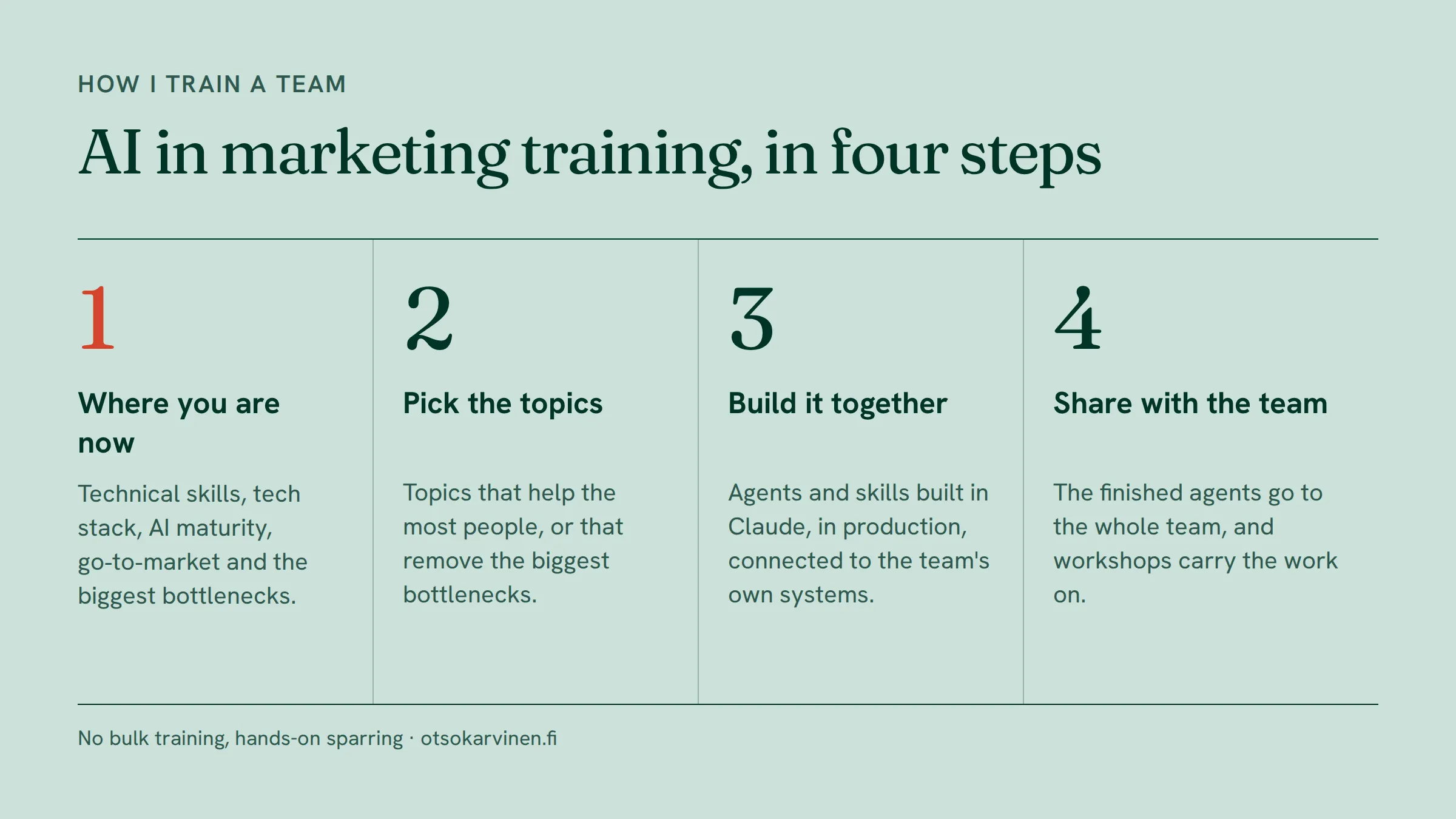
In my experience, AI in marketing training really starts to pay off once the AI tools are connected to the team’s own systems.
That’s why I train sales and marketing teams a bit differently from a typical course.
So to me, AI training is hands-on sparring. The team learns to use AI in its own work and builds its first agents with me, for real use. By an agent I mean AI that handles a task on its own instead of just answering questions.
These days I build teams of AI agents for marketing and sales. More on my background on my AI marketing consultant page.
Who have I trained?
I’ve trained and coached sales and marketing teams on a pretty wide range of topics. The things we’ve talked about most are getting Claude (Anthropic’s AI) to do work on its own, GTM engineering (building the systems and automations behind sales and marketing) and marketing work that runs in several steps.
Where do teams usually start?
Most sales and marketing teams are still pretty early. AI use is basic. Usually Microsoft Copilot gets used for certain tasks, and maybe there are some project folders and files.
But where most teams are really stuck is somewhere else. They haven’t connected their AI tools to the company’s sales and marketing systems yet, like the ad accounts, analytics, the CRM (the customer database) and the email marketing tool. Sometimes they don’t have access, sometimes they don’t know how and sometimes it just hasn’t occurred to them.
Why does AI in marketing need connections to your systems?
Without those connections it’s really hard to build good processes where AI does the work on its own, and to use AI efficiently. AI can actually tell you itself what you should do next, but only if it’s plugged into the right systems and can see their data.
Claude connects to many tools through ready-made connectors, and underneath those is the open MCP standard Anthropic released. I wrote more about what agentic marketing looks like in practice.
How do I train a team?
I never do bulk training where everyone gets the same slides. It’s more like hands-on consulting, and it usually goes like this:
- Look at where you are now. First we go through the team’s current technical skills, tech stack (which tools and systems are in use), AI maturity (how far along they are with AI), go-to-market strategy and the biggest challenges and bottlenecks in the sales and marketing processes.
- Pick the topics. Then we find the topics that would help the most people, or that remove the biggest bottlenecks in those processes.
- Build it together, for real use. We go through the system and the process together and build agents, skills and the rest in Claude for real use, and look at how they work. (A skill is a set of written instructions that lets Claude do a specific task the same way every time.)
- Share it with the team. Finally the agents get shared with the whole team. There can be several workshops where we keep pushing the work forward.
What does the team get out of it?
First, very concrete agents and automations that ease the exact bottlenecks and pain points the team has right now.
Second, understanding. After the training the team has a much clearer idea of what’s actually possible with AI models and agents, and how they’re built and developed, for example in Claude.
Example: a signal agent for a sales team
One concrete example is a signal agent built for a sales team. It keeps watching existing customers for buying signals from different sources: people changing roles, press releases, publications, newsletters, social media activity and website updates. Based on those, it tells a specific salesperson that there could be a buying moment right now.
The same agent looks at prospects (possible new customers) the same way, to see if there’s a moment worth reacting to. On top of that we built a step that finds the key people and fills in their missing contact and background details, so the salesperson can reach the person in the organisation the topic actually belongs to.
I wrote more about the data side of this in how to use AI for sales prospecting.
What does a signal agent change?
It saves a lot of time, but it also does things a person has practically never done before. It follows every target and relevant company at this level of detail, so you can react to signals a lot earlier.
When the outreach lands at a better moment, comes earlier and is more relevant to the company receiving it, the hit rate of sales calls, emails and meetings (how often they lead somewhere) goes up. In my own experience by as much as tens of percent.
We build AI agents for businesses like this at Parvi too, the agency I co-founded.
An AI course or training inside your team?
If you need the basics first, a course is a good start. There are free ones too, for example the University of Helsinki’s Elements of AI.
A course won’t connect AI to your ad accounts or your CRM, though, and it won’t pick which bottleneck to fix first. That takes sparring that starts from your own team’s systems.
I wrote about prices in what AI consulting costs. I also talk about this at company events, more on my AI keynote speaker page.
FAQ
What does AI training for a business include?
In my trainings we first look at where the team is now: technical skills, the systems in use, AI maturity and the biggest bottlenecks in sales and marketing. Then we pick the topics that help the most, build agents together for real use and share them with the whole team. The work usually carries on over several workshops.
Why does AI use often stay at a basic level?
In my experience it's usually because the AI tools aren't connected to the company's own systems, like ad accounts, analytics, the CRM and email marketing. Without those connections it's really hard to build good processes where AI does the work on its own, because the AI can't see the data it would need to suggest what to do next.
What should a team be able to do after AI training?
The team should have concrete agents and automations in use that ease its own bottlenecks. It should also have a much clearer idea of what's actually possible with AI models and agents, and how they're built and developed, for example in Claude.
What's the difference between an AI course and AI training for a team?
A course usually teaches the basics the same way to everyone, and there are good free ones, like the University of Helsinki's Elements of AI. My training starts from the team's own systems and bottlenecks, and at the end the team has agents built for its own work.
What is a sales signal agent?
A signal agent is an AI agent that watches customers and prospects for buying signals, like people changing roles, press releases, publications, newsletters, social media activity and website updates. When something comes up, it tells a salesperson that this could be a good moment to buy. In my own experience this can improve the hit rate of outreach by as much as tens of percent.

Written byOtso Karvinen
I design and build agentic AI systems for marketing and sales teams. Co-founder of Parvi.