AI and market research: how I use it and where it still fails
 Otso Karvinen · Co-founder of Parvi
On this page
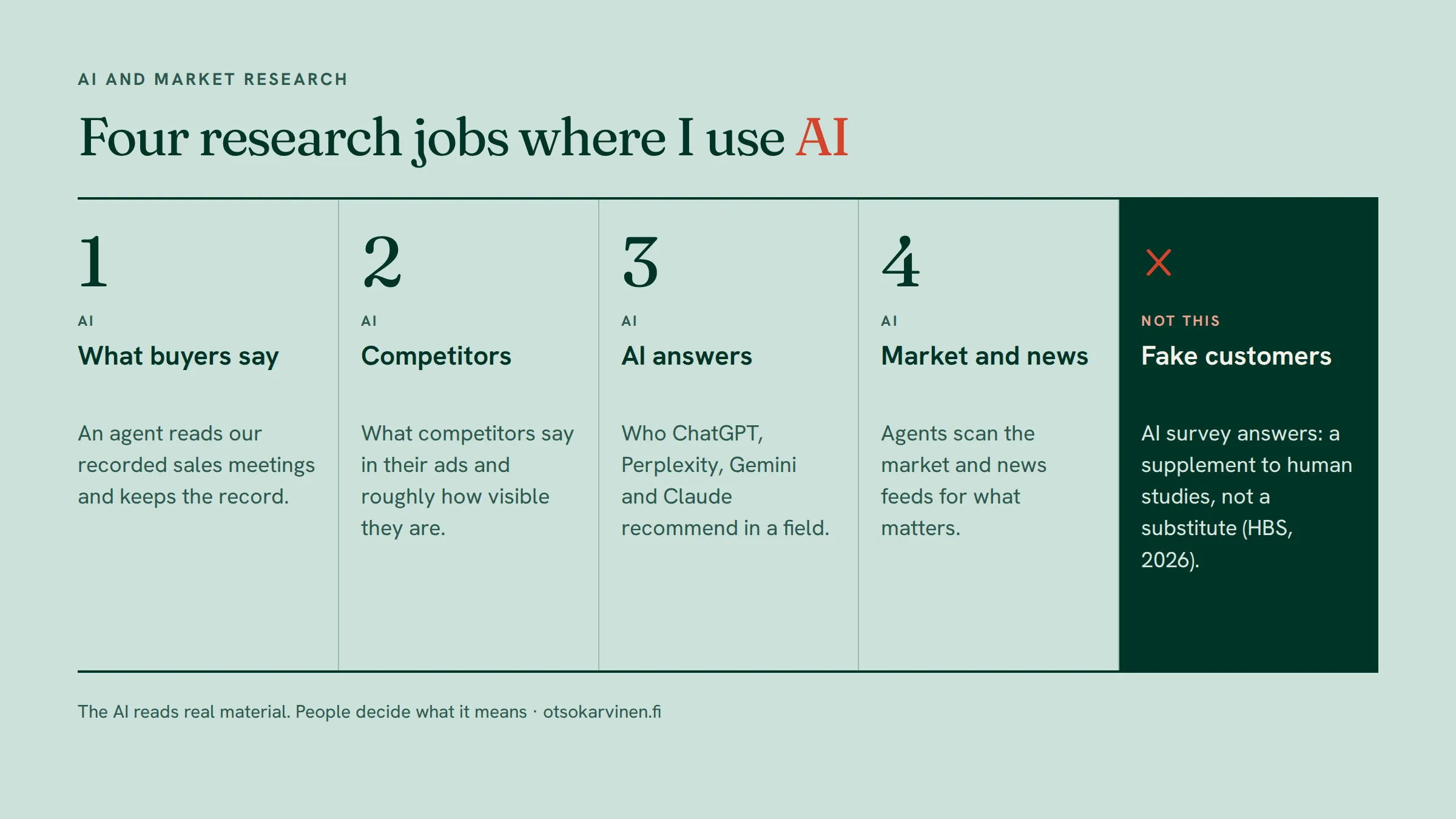
My version of AI and market research is AI reading real material: our recorded sales calls, competitors’ ads and the answers AI tools give about a field. I do it at Parvi and for my own brand. Where it falls short, according to the research so far, is pretending to be your customer.
It’s one part of how I use agentic marketing in my own work and at Parvi, the agentic AI agency for marketing and sales I co-founded.
What is AI market research?
AI market research means using AI tools or AI agents (AI that can work through several steps on its own) to collect and summarise information about your market: customers, competitors, demand and news. A person still decides what the findings mean.
In practice there are two kinds of work. Desk research, where AI reads and summarises what’s already published. And research on your own data, where an agent goes through material only your company has, like meeting recordings or ad accounts. Everything I describe below is the second kind, or close to it.
How I use AI for market research
These are the four research jobs where I use AI:
| Research job | What the AI does | What a person still does |
|---|---|---|
| What buyers say | Reads our recorded sales meetings and keeps the record | Decides what to do with what buyers keep saying |
| Competitors | Compares what competitors say in their ads and roughly how visible they are | Judges whether the budget or its use is the problem |
| AI answers | Asks ChatGPT, Perplexity, Gemini and Claude who they recommend in a field | Checks the answers and picks the fixes |
| Market and news | Scans the market and news feeds | Picks what’s worth acting on |
1. What buyers actually say
We record every client meeting with MeetGeek. An agent goes through each transcript, writes the notes into our CRM (customer database) and creates the follow-up tasks, so over a season it builds a record of what buyers say in their own words.
This autumn the most common thing buyers said to us was “Next year’s budget isn’t set yet.” I know that because the meeting agent’s record says so, not because I ran a survey. The conversations were happening anyway.
What I take from it: when the budget is still open, you can actually influence it and help the person who wants to work with you get it into the plan. The same transcripts feed our proposal builder, which I wrote about in how I write a sales proposal in 15-30 minutes.
2. What competitors are doing
Our LinkedIn ads audits, which our agents run, include a competitor comparison from our ad analyzer, a tool that shows what competitors say in their ads and roughly how much visibility they get.
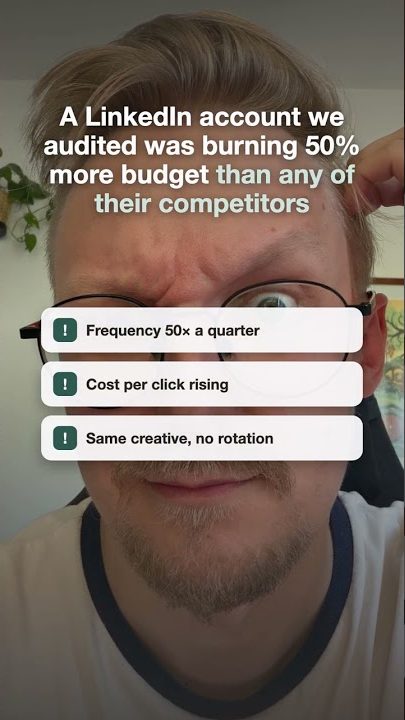
One B2B account we audited was spending roughly 50% more on LinkedIn than any of their competitors, and getting less and less out of it. The same people were seeing their ads around 50 times per quarter, which is two to three times what I’d normally recommend. So the budget wasn’t only big compared to the competition. It was too big for the audience it was trying to reach.
That’s what the competitor view is good for. It tells you a lot about whether you need more budget, or just a better use of the budget you already have. Parvi runs this as a free LinkedIn ads audit, and I talk about that account in this short:
3. What AI tools say about your market
When I need to look something up nowadays, I think nine times out of ten I open Claude, not Google. If your buyers do the same, the AI’s answer is part of your market too.
The free AI visibility checker on this site asks ChatGPT, Perplexity, Gemini and Claude who they’d recommend in your field. It shows your share of the mentions against the competitors the AIs name, and the sites they quote as sources for your category. That’s a quick read on who the AI tools see as the players in your market.
A full audit can turn up bigger surprises. We audited a Finnish industrial company that had changed its name, and in about one in three AI answers that mentioned them, only the old name came up. More on that case in what a company rename does to AI visibility. For a full version of this check, Parvi does an AI visibility audit.
4. Market and news scanning
For my personal brand I run research agents that scan the market and news feeds, as one part of the agent setup behind my content.
For clients, Parvi’s measurement and insights agent team has two agents for this: a market watcher that follows the client’s industry news, filtered through what it knows about the business, and a competitor analyst that reports what competitors are doing and what it means for the client.
Can AI replace surveys and customer interviews?
Not based on the research so far.
The idea is called synthetic respondents: you ask an AI to answer a survey as if it were your customer. A Harvard Business School working paper by James Brand, Ayelet Israeli and Donald Ngwe (latest version April 2026) tested it on willingness to pay (how much customers would pay for a product). The AI-based estimates were sometimes comparable to human studies, but often inaccurate and in some cases pointed the wrong way. Training the model further on earlier survey answers from the same product category helped, but not for new categories or for differences between customer segments. The authors’ conclusion is that AI is a supplement to human studies, not a substitute.
The user research firm Nielsen Norman Group came to a similar view in 2024. AI-generated users often give shallow or overly favourable feedback, and they’re useful for desk research and generating hypotheses, but not for final decisions.
That fits how I use it. Every job in the table above has the AI reading real material: transcripts, ads, real AI answers, published news. None of them asks the AI to invent the customer.
Which AI tools are worth using for market research?
For desk research, start with the AI assistant you already pay for. OpenAI says its deep research “accomplishes in tens of minutes what would take a human many hours”, and in the same post that it “can sometimes hallucinate facts”, meaning it makes them up. So check the sources it cites before a number ends up in a presentation.
For research on your own data, the tool matters less than how it’s connected. Our meeting tool, our CRM and our AI models are part of the same setup, which is why an agent can read a transcript and do something with it. A separate research tool can’t see what was said in your meetings.
What does AI market research cost?
I don’t have a separate figure for research agents. I can tell you what the whole package costs us: around €300 to €400 a month per person, partly because a small team can use cheaper team licences like Claude Team. That’s the models, the tools and the agents together.
Where should you start?
Start with material you already have but nobody reads. Sales call recordings are an easy first pick, because the information is already sitting there, unused. Record the meetings and let an agent write the notes. After a few weeks, ask it what buyers keep saying.
Researching potential customers is a close relative of this, and I’ve written about it in how to use AI for sales prospecting.
FAQ
What's the best AI tool for market research?
For desk research, the big AI assistants have research modes. ChatGPT's deep research is one, and I mostly use Claude. OpenAI itself says its tool can sometimes get facts wrong, so check the sources before a number goes anywhere. For research on your own material, like sales meeting transcripts, you need AI that is connected to that material, because no public tool can see it.
Can AI replace surveys and customer interviews?
Not based on the research so far. A Harvard Business School working paper (latest version April 2026) found that AI estimates of what customers would pay were sometimes close to estimates from human studies, but often inaccurate and in some cases wrong in direction. The authors call AI a supplement to human studies, not a substitute. Nielsen Norman Group says AI-generated users are useful for generating hypotheses, not for final decisions, so test those hypotheses with real customers.

Written byOtso Karvinen
I design and build agentic AI systems for marketing and sales teams. Co-founder of Parvi.