AI-powered content creation: how I do it without it sounding like AI
 Otso Karvinen · Co-founder of Parvi
On this page
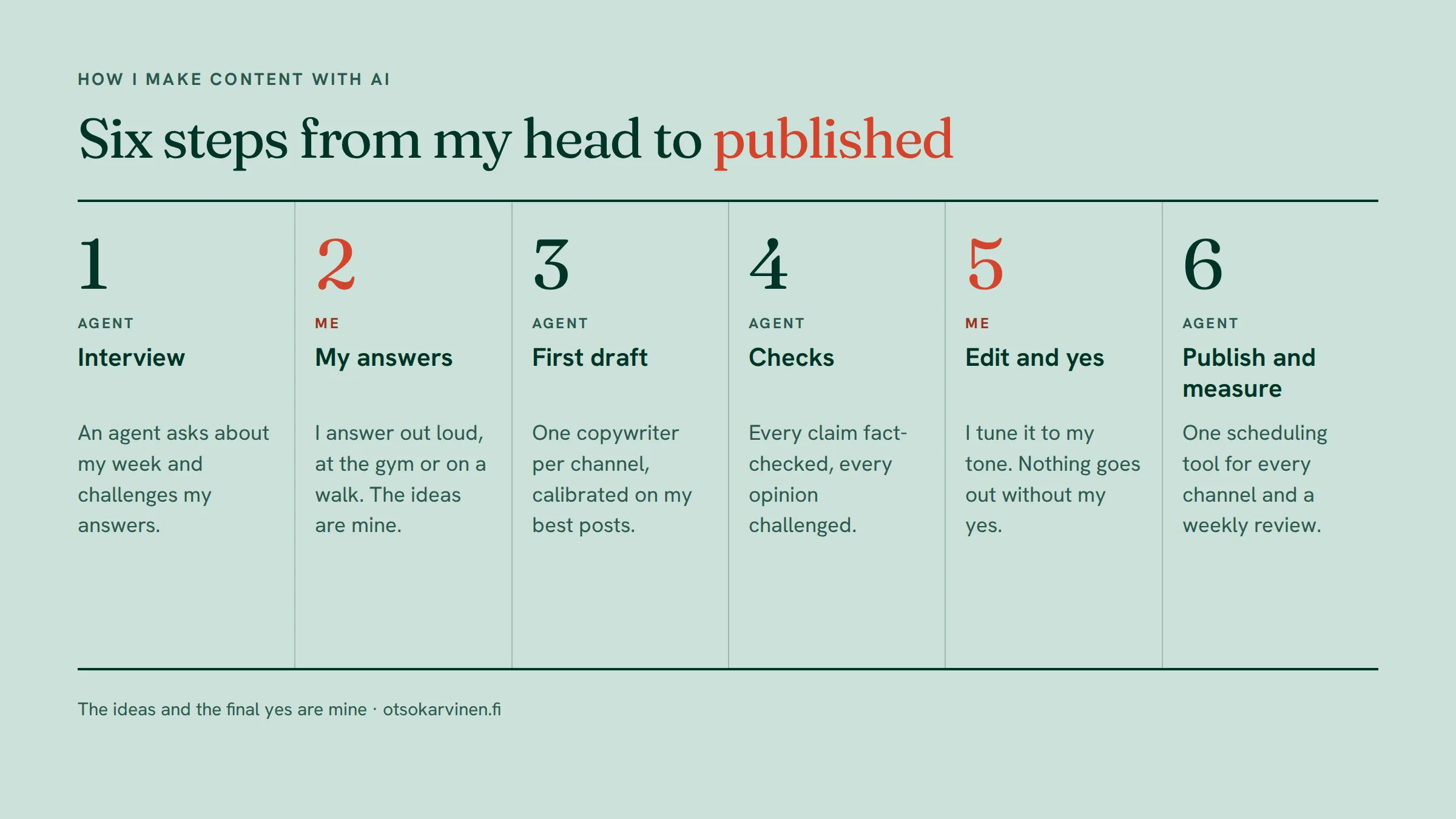
AI-powered content creation means using AI to plan, write, edit, publish and measure content. I use it for nearly all of my personal brand: an agent interviews me, other agents draft, check, publish and report, and I spend my time on the ideas and the final yes.
Used the quick way (ask for a text about a topic), AI tends to give you generic text. This is how I set mine up so the result still sounds like me. It’s part of how I use agentic marketing in my own work.
What is AI-powered content creation?
It’s content made with the help of AI tools or AI agents (AI that can take several steps on its own, like drafting, checking and scheduling a post). The AI can help at every stage: picking topics, drafting text, making images, editing video, publishing and reading the results.
Whether it works depends on who brings the substance. If the AI only gets a topic, you get text that could be on anyone’s website. If it gets your ideas, your examples and your numbers, it can do the rest of the work.
Does AI content creation actually work?
For speed, yes. For quality, it depends on how you use it. The Content Marketing Institute and MarketingProfs survey of 861 B2B marketers (fielded June to August 2026) asked what generative AI has done for their content creation. 78% said speed and 59% efficiency. Only 17% said quality.
The biggest problems they named were ensuring accuracy (54%), quality control (54%) and keeping the brand voice and authenticity (52%). That matches what I see. Producing more content is easy now. Making it accurate and making it sound like you is where the work is.
AI is also everywhere already. Ahrefs checked 900,000 new web pages from April 2025 and found AI-generated content on 74.2% of them. So using AI alone won’t make your content stand out.
How I use AI for content creation
My setup runs on Claude Code (Anthropic’s tool for running AI agents with your own instructions), and every agent has its own written instructions. These are the steps a post goes through:
- An agent interviews me. A journalist agent asks me questions about my week, follows up and challenges my reasoning. When I mention a report, it looks for opposing views. I answer out loud, often between sets at the gym or on a walk, and my phone transcribes it.
- The ideas come from my answers. One hour’s walk once got me the week’s posts drafted. The topics, opinions and examples are mine, because they come out of what I said.
- An agent writes the first draft. There’s a copywriter agent for each channel, each calibrated on my own top-performing posts, so a LinkedIn post and a Threads post don’t read like the same text pasted twice.
- Agents check it. One fact-checks every claim and another steel-mans every opinion (finds the strongest argument against it), so I see the weak spots before anyone else does.
- I edit it and say yes. I read the whole thing, fix what’s off and tune it into my own tone. Nothing goes out without my explicit yes.
- An agent publishes and another measures. Posts go out through one scheduling API (Zernio) to all my channels, and every week an agent pulls the numbers back into one dashboard and a short review.
I also have agents for images and video: one renders branded images and carousels, another cuts my talking-head videos with captions and graphics. The principle is the same everywhere: the agents do the production, and I keep the opinions, the tone and the taste.
I explain the interview agent in this short:

How do you keep AI content from sounding generic?
Start before the AI writes anything. This is what has made the difference for me:
- Get interviewed first. Being asked questions is a very different experience from trying to write from a blank page. I built the journalist agent to help me think, and the content is really a byproduct of that.
- Give it a voice guide built from your own writing. Mine is built from my own LinkedIn posts: how I open, how long my sentences are, which words I use and which I never use.
- Check for AI phrases on purpose. Before I see a draft, it goes through a check for the typical tells: words like “delve” and “seamless”, “it’s not X, it’s Y” sentences, tidy three-part lists and summary endings.
- Keep your real numbers and hedges. If I said “about half”, the text says about half, not 50%.
I learned the first point the hard way. When I set up an agent to write longer articles for this site, the first version drafted cold and added my answers afterwards. My verdict on the result was that it sounded like somebody else was writing. So I changed the order: the interview comes first, and the draft is written from my answers.
What AI doesn’t do in my content
It doesn’t decide what I think, publish anything on its own or make up results.
I don’t think something stops being mine because AI was involved. For my own posts the original ideas are mine, and the first writing is usually my own words, spoken into the phone. Some content starts as an AI draft, and then I check everything in it and tune it into my tone. I compare it to a film director: they don’t write the script or hold the camera, but it’s their film because they make the judgment calls.
Handing the whole job to AI doesn’t work either. With ad creatives, for example, pointing an AI at the whole problem gives you off-brand slop: wrong logo, wrong colours, broken layouts and generic copy. What I’ve been testing instead is locking the brand elements in templates and letting AI fill only the parts that are allowed to vary.
What has it brought?
Mostly scale I couldn’t do by hand. I publish on eight channels plus this website, and it’s basically one person doing the work of a small content team.
The bigger change for me is where the work happens. My content work doesn’t need a desk anymore, so it fits into time I was already spending at the gym or on a walk.
It has also brought leads. In October one of my LinkedIn posts reached about 32,000 people, and the next day we got five inbound leads. I wrote more about what my posts have done for sales in founder-led sales at Parvi.
Does Google penalize AI-generated content?
Not for being AI-generated. Google’s guidance on AI-generated content says “appropriate use of AI or automation is not against our guidelines”. What breaks its spam policies is using automation with the primary purpose of manipulating search rankings.
Google says it rewards original, high-quality content however it is produced. In practice that brings you back to the same point: first-hand experience and real examples are what make a page worth ranking, and those have to come from you.
Do you have to tell readers that AI was used?
For most marketing content in the EU, probably not, if a person really reviews it and takes editorial responsibility for it. My co-founder Mari Luukkainen went through the EU AI Act’s new labelling rules on Parvi’s blog, and the labelling duty for AI text is narrower than many think. It’s not legal advice, so check your own case.
My own rule: anything going out into the world goes through a person who checks it and owns it. Internal automated messages, like an agent’s status update in Slack, say plainly that AI wrote them.
Where should you start?
Start with the step that’s hardest for you. For me it was getting ideas out of my head, not the writing itself. An agent that interviews you once a week is a good first build, and you’ll learn quickly what you want the AI to do next.
If you’d rather not build it yourself, Parvi builds this kind of setup for founders and executives as a personal brand agent team, and for company channels as a content and social agent team. More on the rules I give agents in what to let a marketing AI agent do.
FAQ
Which AI is better than ChatGPT for writing?
I run most of my writing work on Claude, through Claude Code with my own written instructions for each step. To me the model matters less than what you give it: your own ideas, examples and a voice guide built from your best posts. A generic prompt gets a generic text from any model.
Can AI write in my own tone of voice?
It can get close if you give it enough of your own writing. My copywriter agents are calibrated on my own top-performing posts and follow a voice guide built from them. I still edit every post before it goes out, and long articles are the hardest to get right.

Written byOtso Karvinen
I design and build agentic AI systems for marketing and sales teams. Co-founder of Parvi.