How to be more efficient with Claude: Opus 5 is the workhorse
On this page
For the past year the pattern in AI models has been annoying but consistent: the models that got smarter and more efficient also got more expensive. I even posted a short about exactly that. And then Anthropic released Claude Opus 5 and broke the pattern.

That’s me, being wrong. These things change fast and you have to keep re-checking what you think you know.
Credit where it’s due: my friend Jarno Silander told me to take a proper look at Opus 5 as the daily driver. I didn’t take it on faith. I read the system card, the docs and the early reviews, then tested it on my own setup. This article is what came out of that.
Claude Opus 5 vs Fable 5: the receipts
Fable 5 is Anthropic’s most capable model and it’s priced like it: $10 per million input tokens, $50 per million output. Opus 5 costs exactly half, $5 and $25.
The surprising part is how little capability you give up. From the Opus 5 system card:
| Benchmark | Opus 5 | Fable 5 |
|---|---|---|
| FrontierCode (agentic coding) | 53.4 | 53.5 |
| Humanity’s Last Exam (no tools) | 56.3 | 56.5 |
| BrowseComp (agentic search) | 90.8 | 87.4 |
| OSWorld 2.0 (computer use) | 70.6 | 66.1 |
| FrontierBench v0.1 | 44.4 | 33.7 |
Read that again. The half-price model wins on three of those five. Fable still leads on the hardest long-horizon reasoning, but for the work most of us do all day, the gap is basically gone.
The system card has one more finding I didn’t expect: Opus 5 hit its best FrontierCode score at medium effort. Anthropic’s own docs now recommend using the low and medium settings liberally. More thinking is not automatically better on this model.
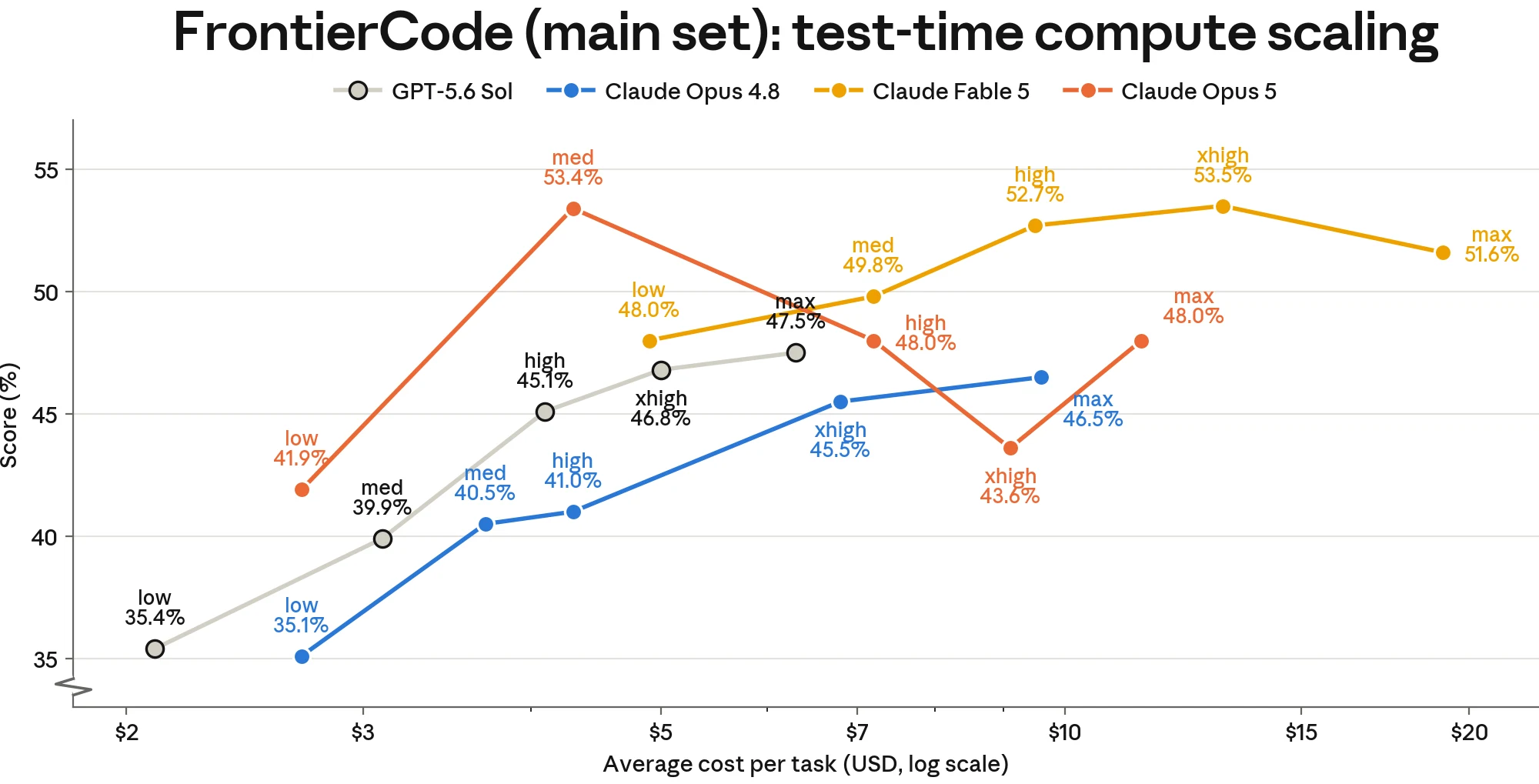
Look at where the orange line peaks. Opus 5 at medium effort scores 53.4% at around $4 per task. Fable 5 gets to 53.5%, but it takes its xhigh setting and about $13 per task to do it. Same result, three times the cost. (Chart: Anthropic, Claude Opus 5 system card, figure 8.4.A.)
The config I run now
I used to run the expensive model with cheap settings. Fable as my main model, effort turned down, plus a hook that blocked my subagents from inheriting Fable and forced them onto cheaper models. My whole setup was built to compensate for Fable’s price.
Here’s what I changed:
- Opus 5 as the default model. In Claude Code that’s
"model": "claude-opus-5"in settings.json, or just/model. It has the same 1M context window as Fable, at standard pricing. - Start at high, drop to medium where quality holds. That’s Anthropic’s own guidance: begin at the high default and sweep down on your own work. For my daily sessions medium holds, so that’s where I run. On the coding benchmark above medium was literally the best score, but that won’t be true of every workload, so test on yours.
- Fable as the escalation, not the default. It’s still there when a session actually needs the ceiling. I just stopped paying flagship prices for routine work.
- Dropped the subagent restrictions. At Opus prices my subagents can just inherit the main model. The enforcement hook I wrote is now mostly retired. Removing complexity felt good.
- Scheduled agents run on the cheaper model too. This one matters more than people think. I have about 5 daily and 5 weekly scheduled agents running through the day, and they consume tokens whether I’m watching or not. Model choice is a multiplier on all of it.
One honest caveat before you copy this config. Opus 5 talks more than earlier models and it delegates to subagents more eagerly, which can quietly eat into the savings. Anthropic says so themselves in the prompting guide, and the review on Lenny’s Newsletter called it brilliant but annoying for the same reason. Ask it to keep output concise and cap the delegation, and the math holds.
What it saves
The math is simple because the price ratio is exactly 2x. An illustration with my kind of usage, around 15 sessions of ~200k tokens a day (assuming a typical 80/20 input/output split):
| Fable 5 | Opus 5 | |
|---|---|---|
| One 200k session | $3.60 | $1.80 |
| 15 sessions a day | $54 | $27 |
| A month | ~$1,620 | ~$810 |
About $810 a month at API rates, for output that benchmarks the same. On a subscription the same math shows up as your usage limits stretching roughly twice as far.
Caching discounts apply to both models equally, so none of this changes the ratio.
The system card backs this up at the per-task level too. On DeepSWE, a long-horizon coding benchmark, Opus 5 at medium effort scores 66.9% at roughly $3 per task. Fable 5 needs its max setting and over $20 per task to reach 69.7%. The whole orange curve sits above and to the left of the others:
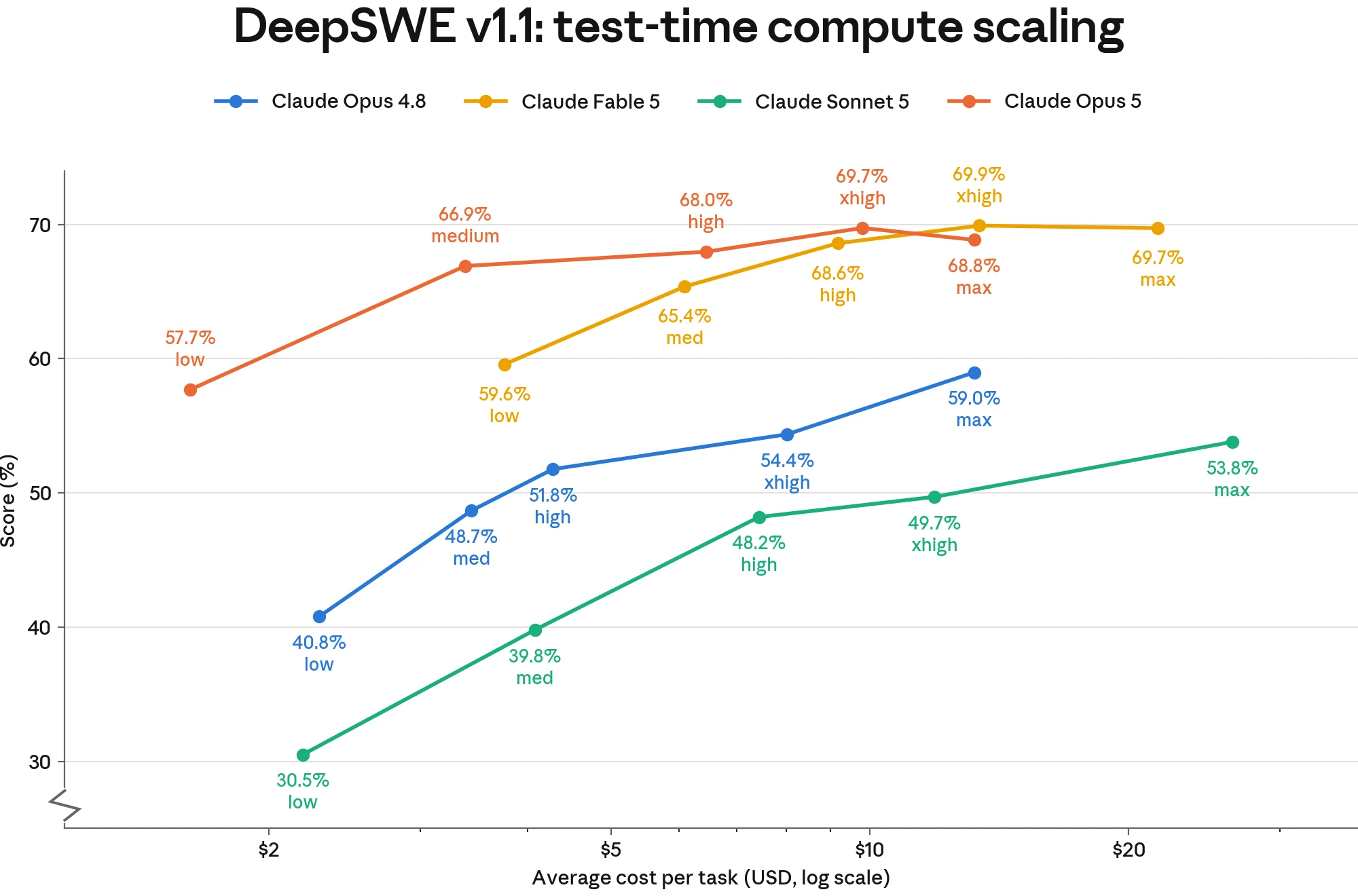
(Chart: Anthropic, Claude Opus 5 system card, figure 8.3.A.)
Why this matters beyond the power users
If you’re on a plan that doesn’t include Fable at all, this is the actual news: the workhorse tier just got near-flagship. You’re not settling for the second-best model anymore. On several agentic benchmarks you’re running the better one.
And if you’re starting to run agents on a schedule, research agents, reporting agents, whatever your version of that is, the economics of the model you default to compound daily. That’s the question I’d ask of every model release from now on: what does my actual workload cost on this one.
I was wrong about the pricing trend. Happy to be.
FAQ
Should I use Claude Opus 5 or Fable 5?
For most daily work, Opus 5. On Anthropic's own system card it matches Fable 5 on coding benchmarks like FrontierCode (53.4 vs 53.5) and beats it on several agentic ones, at half the token price. Fable 5 still makes sense as an escalation for the hardest long-horizon work, if your plan includes it.
What are Claude's effort levels?
A setting (low, medium, high, xhigh, max) that controls how much the model thinks and works per request. More effort means more tokens and time. On Opus 5 the interesting part is that medium produced the best score on the FrontierCode coding benchmark, so more effort is not automatically better.
Is Claude Opus 5 cheaper to run than Fable 5?
Yes, exactly half: $5 per million input tokens and $25 per million output tokens, vs Fable 5's $10 and $50. The ratio holds whatever your workload looks like, and on a subscription the same math stretches your usage limits about twice as far.
When is Fable 5 still worth it?
The most demanding reasoning and very long autonomous runs. I keep it as an on-demand escalation for genuinely hard sessions, not as the default. If you don't have access to Fable at all, Opus 5 at medium effort is a very good place to be.